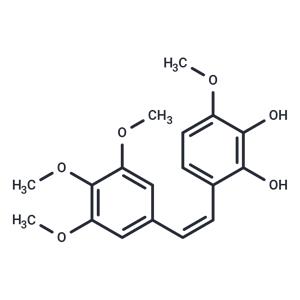
| Name | Combretastatin A-1 |
| Description | Combretastatin A-1 is a potent microtubule inhibitor with anti-tumour and anti-vascular activity, acting through microtubule protein depolymerisation-mediated inactivation of AKT to inhibit the Wnt/β-catenin pathway, and can be used to study hepatocellular carcinoma. |
| In vitro | Combretastatin A-1 (CA1P) induces apoptosis of TAMs in vitro through the same mechanism observed in HepG2 cells, and it eliminates TAMs in the tumor microenvironment (TME) in vivo. Combretastatin A-1 (1-10 nM; 24 hours) induces AKT inactivation and removal of GSK-3β inhibition by microtubule depolymerization, leading to HepG2 cell apoptosis [2]. Combretastatin A-1 (1-50 nM; 6 hours) reduces the mitochondrial membrane potential (MMP) of HepG2 cells and induces the accumulation of ROS in a dose-dependent manner [3]. |
| In vivo | In the HepG2 subcutaneous xenograft model, Combretastatin A-1 (1-4 mg/kg; i.v. every other day for 4 weeks) significantly reduces the tumor volume [3].
In the orthotopic hepatocellular carcinoma mouse model, Combretastatin A-1 (2 mg/kg; every other day for 21 days) demonstrates enhanced apoptosis [3]. |
| Storage | Shipping with blue ice/Shipping at ambient temperature. |
| Solubility Information | 10% DMSO+40% PEG300+5% Tween 80+45% Saline : 3.3 mg/mL (9.93 mM), Sonication is recommended.
DMSO : 80 mg/mL (240.71 mM), Sonication is recommended.
DMF : 5 mg/mL (15.04 mM), Sonication is recommended.
Ethanol : 3 mg/mL (9.03 mM), Sonication is recommended.
DMSO:PBS (pH 7.2) (1:1) : 0.5 mg/mL (1.5 mM), Sonication is recommended.
|
| Keywords | MicrotubuleAssociated | Microtubule Associated | microtubule | Combretastatin A-1 | Combretastatin A 1 | Akt |
| Inhibitors Related | Aceglutamide | Flubendazole | Musk ketone | Urea | Bisphenol A | Hyaluronic acid | Neohesperidin | Ethyl linoleate | α-Cyclodextrin | Methylene Blue trihydrate | Methyl eugenol | 2,3-Butanediol |


 United States