Items | Specifications | Results |
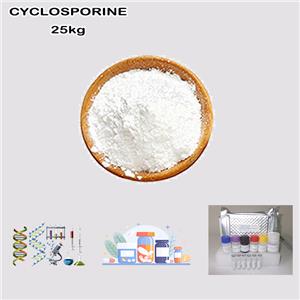
Appearance | White or off-white powder,odorless. | Conform |
Assay | 97.0%~101.5% | 99.2% |
Identification | Spectroscopic Identification Tests-Infrared Spectroscopy:Meet the requirement. HPLC:The retention time of the major peak of the Sample solution corresponds to that of the Standard solution,as obtained in the Assay. | Conform Conform |
Individual impurity | ≤0.7% | 0.4% |
Total impurities | ≤1.5% | 1.0% |
Loss on drying | ≤2.0% | 0.4% |
TAMC | ≤103 cfu/g | <10 cfu/g |
TYMC | ≤102 cfu/g | <10 cfu/g |
E.coli | Not Detected | N.D |
Conclusion | The product conforms to the above specifications. |
Cyclosporine is a potent immunosuppressant medication, originally isolated from a soil fungus. It revolutionized the field of organ transplantation and remains a cornerstone drug for preventing organ rejection and treating severe autoimmune diseases.
What it is (Pharmacology)
Type: Calcineurin Inhibitor (CNI). It selectively suppresses a specific part of the immune system.
Source: A cyclic polypeptide derived from the fungus Tolypocladium inflatum.
Primary Mechanism: It blocks the activation of T-lymphocytes (T-cells), which are the white blood cells that play a central role in orchestrating the immune system's attack on "foreign" tissue (like a transplanted organ) or in autoimmune reactions.
Formulations: Available in oral (capsules, solution) and intravenous (IV) forms. Common brand names include Neoral, Sandimmune, and Gengraf. (Note: Neoral and Sandimmune are not directly interchangeable due to different absorption profiles).
Primary Uses
Cyclosporine's main function is to deliberately suppress the immune system. Its uses fall into three major categories:
1. Organ and Tissue Transplantation (Prophylaxis of Rejection)
This is its most critical and life-saving use. It is used as a long-term maintenance drug to prevent rejection of:
It is almost always used in combination with other immunosuppressants (like corticosteroids, mycophenolate, or sirolimus) to allow for lower doses of each drug and reduce side effects.
2. Autoimmune and Inflammatory Diseases
Used for severe, treatment-resistant cases where conventional therapies have failed. Common uses include:
Severe Psoriasis: For extensive plaque psoriasis that is unresponsive to topical treatments, phototherapy, or systemic non-immunosuppressants.
Severe Atopic Dermatitis (Eczema): For cases that are debilitating and unresponsive to other treatments.
Rheumatoid Arthritis: Used in active, severe cases, typically after failing disease-modifying anti-rheumatic drugs (DMARDs).
Autoimmune Eye Diseases: Such as severe uveitis.
Autoimmune Blood Disorders: Like aplastic anemia in some cases.
Nephrotic Syndrome: A kidney disorder characterized by massive protein loss in urine.
3. Topical Use (Cyclosporine Ophthalmic Emulsion)
Important Considerations and Side Effects
Cyclosporine is a powerful drug with a narrow therapeutic index (the difference between an effective dose and a toxic dose is small). Its use requires careful medical supervision and regular monitoring.
Major Side Effects and Risks:
Nephrotoxicity (Kidney Damage): This is the most serious and common dose-limiting side effect. Kidney function must be monitored closely.
Hypertension (High Blood Pressure): Very common, often requiring management with anti-hypertensive medications.
Increased Risk of Infections: Due to suppressed immune system.
Increased Risk of Malignancies: Particularly skin cancers and lymphomas.
Neurotoxicity: Tremors, headaches, paresthesia (tingling).
Hyperlipidemia: Increased cholesterol and triglycerides.
Gingival Hyperplasia: Overgrowth of gum tissue.
Hirsutism: Excessive hair growth.
Gastrointestinal Upset: Nausea, diarrhea.
Crucial Monitoring Parameters (while on therapy):
Blood cyclosporine levels (trough levels)
Serum creatinine and kidney function (frequently)
Blood pressure
Liver function tests
Lipid profiles
Magnesium and potassium levels
Drug Interactions: Cyclosporine has numerous and significant drug interactions. It is metabolized by the liver enzyme system CYP3A4. Key interactions include:
Drugs that increase levels (risk of toxicity): Macrolide antibiotics (e.g., clarithromycin), antifungals (e.g., ketoconazole), calcium channel blockers (e.g., diltiazem, verapamil), grapefruit juice.
Drugs that decrease levels (risk of rejection): Anticonvulsants (e.g., phenytoin, carbamazepine), rifampin, St. John's Wort.
Summary Table
| Feature | Cyclosporine |
|---|
| Drug Class | Calcineurin Inhibitor (CNI) Immunosuppressant |
| Primary Action | Inhibits T-lymphocyte (T-cell) activation |
| Key Uses | 1. Prevent organ transplant rejection
2. Severe autoimmune diseases (psoriasis, eczema, RA)
3. Topical: Chronic inflammatory dry eye (Restasis) |
| Administration | Oral (capsules/solution), Intravenous (IV), Ophthalmic (eye drops) |
| Critical Monitoring | Kidney function, Blood pressure, Drug blood levels, Lipids |
| Major Risks | Nephrotoxicity, Hypertension, Infections, Cancer risk, Drug interactions |
Disclaimer: This information is for educational purposes only. Cyclosporine is a serious prescription medication with potentially severe side effects and interactions. Its use must be managed by a specialist physician (e.g., transplant specialist, rheumatologist, dermatologist) with appropriate monitoring protocols in place.







 China
China