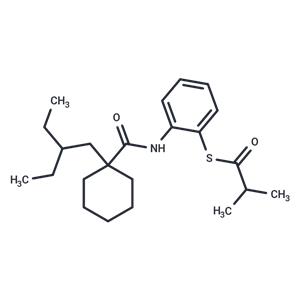
| Name | Dalcetrapib |
| Description | Dalcetrapib (RO4607381), a rhCETP inhibitor (IC50=0.2 μM), increases the plasma HDL cholesterol. |
| Cell Research | The HepG2 cells are seeded in 6-well plates and cultured to 70–80% confluence. After being washed with PBS, the cells are incubated with growth medium and a different concentration (0 μM–30 μM) of chemical inhibitor Dalcetrapib and dissolved in 2% DMSO for 24 hours. Total RNA is used for RT-PCR.(Only for Reference) |
| Kinase Assay | Inhibition of rhCETP and C13S CETP-mediated transfer of CE from HDL to LDL: The inhibitory potency (IC50) of Dalcetrapib to decrease CE transfer from HDL to LDL by rhCETP and C13S CETP is measured using a scintillation proximity assay kit. Briefly, [3H]CE-labeled HDL donor particles are incubated in the presence of purified CETP proteins (final concentration 0.5 μg/mL) and biotinylated LDL acceptor particles for 3 hours at 37 °C. Subsequently, streptavidin-coupled polyvinyltoluene beads containing liquid scintillation cocktail binding selectively to biotinylated LDL are added, and the amount of [3H]CE molecules transferred to LDL is measured by β counting. |
| In vitro | Dalcetrapib modulates CETP activity. Dalcetrapib induces a conformational change in CETP, when added to human plasma. CETP-induced pre-β-HDL formation in human plasma is unchanged by Dalcetrapib ≤3 μM and increased at 10 μM. Dalcetrapib statistically and significantly increases pre-β-HDL formation. [1] Dalcetrapib achieves 50% inhibition of CETP activity in human plasma at a concentration of 9 μM. [2] Dalcetrapib inhibits the CETP activity of media in HepG2 in a dose-dependent manner. [3] |
| In vivo | Treatment with Dalcetrapib leads to significant increases in HDL-C levels. In hamsters injected with [3H]cholesterol-labeled autologous macrophages Dalcetrapib significantly increases fecal elimination of both [3H]neutral sterols and [3H]bile acids. Dalcetrapib increases plasma HDL-[3H]cholesterol. [1] Dalcetrapib has 95% inhibition of CETP activity in male Japanese white rabbits at an oral dose of 30 mg/kg. Dalcetrapib increases the plasma HDL cholesterol level by 27% and 54%, respectively, when given at oral doses of 30 mg/kg or 100 mg/kg once a day for 3 days to male Japanese white rabbits. [2] Treatment with Dalcetrapib markedly increases serum levels of HDL-C. The ratio of HDL2-C to HDL3-C is significantly higher in Dalcetrapib–treated rabbits than in control rabbits at 5 and 7 months, indicating that the inhibition of CETP activity by Dalcetrapib changes the distribution of HDL subfractions and preferentially increases HDL2-C levels. Dalcetrapib treatment increases serum paraoxonase activity and HDL-associated platelet-activating factor acetylhydrolase activity, but decreases the plasma lysophosphatidylcholine concentration. [4] |
| Storage | Powder: -20°C for 3 years | In solvent: -80°C for 1 year | Shipping with blue ice/Shipping at ambient temperature. |
| Solubility Information | DMSO : 72 mg/mL (184.81 mM), Sonication is recommended.
Ethanol : 72 mg/mL (184.81 mM), Sonication is recommended.
H2O : < 1 mg/mL (insoluble or slightly soluble)
10% DMSO+40% PEG300+5% Tween 80+45% Saline : 2 mg/mL (5.13 mM), Sonication is recommended.
|
| Keywords | RO-4607381 | RO 4607381 | rhCETP | orally active | JTT705 | JTT 705 | Inhibitor | inhibit | HDL cholesterol | Dalcetrapib | Cholesteryl ester transfer protein | CETP |
| Inhibitors Related | Anacetrapib | Evacetrapib | 3-Pyridinemethanol | Torcetrapib | 20-HC-Me-Pyrrolidine | Implitapide | CETP-IN-3 | BMS-188494 | TAP311 | CETP-IN-4 | CP-532623 | Obicetrapib |
| Related Compound Libraries | Failed Clinical Trials Compound Library | Target-Focused Phenotypic Screening Library | Bioactive Compound Library | ReFRAME Related Library | Drug Repurposing Compound Library | Inhibitor Library | NO PAINS Compound Library | Anti-Cardiovascular Disease Compound Library | Lipid Metabolism Compound Library | Clinical Compound Library | Bioactive Compounds Library Max | Human Metabolite Library |


 United States