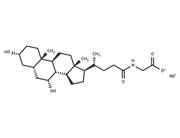
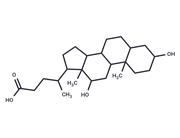
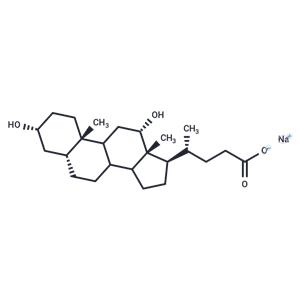
| Name | Deoxycholic acid sodium salt |
| Description | Deoxycholic acid sodium salt (Sodium deoxycholate) can activate the G protein-coupled bile acid receptor TGR5 that stimulates brown adipose tissue (BAT) thermogenic activity. |
| Cell Research | MGC803 cells are cultured in Roswell Park Memorial Institute media supplemented with 10% fetal calf serum and 100 U/mL Penicillin and 100 mg/mL Streptomycin. To generate MGC803-resistant cells, the pH value of the MGC803 culture medium is adjusted to the experimental conditions using the hydrochloric acid (A). The bile acids GCDA and Deoxycholic acid are diluted to optimal working concentrations of 100 μM (B) with culture medium, and the overall pH (A+B) is adjusted to pH 5.5, simulating the gastric environment. Initially, MGC803 cells are chronically exposed to acidified medium with bile acids (A+B) for 10 min every 24 h. The experimental time and conditions are optimized in our preliminary experiments, which show that 10 min is enough and does not result in cell damage. This procedure is repeated and it takes 60 weeks for the MGC803 cells to survive and proliferate under the exposure of A+B for 120 min. Control untreated cells are cultured in neutral RPMI medium at pH 7.4 in parallel to the resistant cells for 60 weeks. The morphological changes in MGC803 cells exposed to acidified bile acids (A+B) are documented at 30 and 60 weeks[2]. |
| In vitro | Deoxycholic acid (DCA) and chenoDeoxycholic acid (CDCA) are the common ingredients of duodenal reflux that act synergistically in many physiological and pathological processes. The cells are repeatedly exposed to 100 μM CDCA and Deoxycholic acid at pH 5.5 for up to 120 min. To simulate chronic local recurrent disease in vitro, the gastric cancer cell line MGC803 is exposed to acidified medium (pH 5.5) containing 100 μM Deoxycholic acid and CDCA. An untreated log-growth MGC803 cell line is generated to be used as a control in normal pH media. After daily 10 min exposure to the acidified bile acids for 60 weeks, MGC803-resistant cells are able to survive and proliferate after 120 min exposure [2]. |
| Storage | Shipping with blue ice/Shipping at ambient temperature. |
| Solubility Information | 10% DMSO+40% PEG300+5% Tween-80+45% Saline : 0.5 mg/mL (1.21 mM), Sonication is recommended.
H2O : 330 mg/mL (796.02 mM), Sonication is recommended.
DMSO : 20 mg/mL (48.24 mM), Sonication is recommended.
|
| Keywords | TGR5 | Inhibitor | inhibit | G-protein coupled receptor 19 | GPCR19 | GPBAR1 | G protein-coupled Bile Acid Receptor 1 | G protein-coupled bile acid receptor | EndogenousMetabolite | Endogenous Metabolite | Deoxycholic acid sodium salt | Deoxycholic acid sodium | Deoxycholic acid | bile acid |
| Inhibitors Related | Sucrose | Aceglutamide | Nicotinamide riboside malate | DL-Lysine | D(+)-Raffinose pentahydrate | Guanidine hydrochloride | Malic acid | Formamide | Glycerol | Thymidine | Corn starch | Gluconate Calcium |
| Related Compound Libraries | Bioactive Compound Library | Membrane Protein-targeted Compound Library | Anti-Cancer Clinical Compound Library | Drug Repurposing Compound Library | Microbial Natural Product Library | NO PAINS Compound Library | FDA-Approved Drug Library | Anti-Cancer Approved Drug Library | Bioactive Compounds Library Max | GPCR Compound Library | Anti-Cancer Active Compound Library | Anti-Cancer Drug Library |


 United States