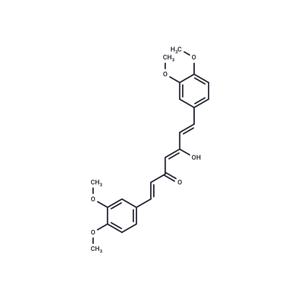
| Name | Dimethylcurcumin |
| Description | Dimethylcurcumin (ASC-J9) (ASC-J9) is an androgen receptor degradation enhancer. It effectively suppresses castration-resistant prostate cancer cell proliferation and invasion. |
| Cell Research | For the cell survival assay, the PC12/AR-112Q and PC12/AR-10Q cells are cultured as described previously and incubated cells in the presence of 10 μg/mL doxycycline for 24 h. Then the cells are treated with a vehicle, 5 μM Dimethylcurcumin or 10 μM Dimethylcurcumin, along with 1 nM DHT, and determined cell viability using Trypan blue staining at specific time intervals [2]. |
| Animal Research | CWR22Rv1 cells (1×10^6 cells per site) are injected into both anterior prostates of the castrated nude mice after 2 weeks of implantation. The mice were randomly divided into two groups (four mice/eight tumors each group) and either receive 75 mg/kg Dimethylcurcumin intraperitoneal injection or vehicle control every other day. After 4 weeks of treatment, all mice are killed to examine the tumor growth. Body weights and mice activity are measured weekly [1]. |
| In vitro | Dimethylcurcumin is able to degrade fAR and AR3 in a dose-dependent manner in various human PCa cells. Dimethylcurcumin can also effectively suppress AR-targeted genes in CWR22Rv1-fARKD cells. Dimethylcurcumin (5 or 10 μM) significantly suppresses the DHT-induced cell growth in all three PCa cell lines. Dimethylcurcumin suppresses AR-targeted genes and cell growth by the degradation of fAR and ectopic AR3 in C81 and C4-2 cells [1]. ASC-J9 reduces the AR aggregated AR-112Q in cells. Dimethylcurcumin suppresses the aggregation of AR-112Q in SBMA PC12/AR-112Q cells [2]. |
| In vivo | Dimethylcurcumin (75 mg/kg, i.p.) degrades both fAR and AR3 in the xenografted tumors in vivo and ASC-J9-treated tumors have significantly decreased Ki67-positive cells [1]. Dimethylcurcumin (50 mg/kg every 48 h, i.p.) substantially ameliorates the SBMA symptoms in AR-97Q mice and ameliorates neuromuscular pathological findings [2]. ASC-J9-treated mice show significantly smaller prostate tumor sizes when compared with those receiving classic ADT/castration with little serum androgen [3]. |
| Storage | Powder: -20°C for 3 years | In solvent: -80°C for 1 year | Shipping with blue ice/Shipping at ambient temperature. |
| Solubility Information | 10% DMSO+40% PEG300+5% Tween 80+45% Saline : 2 mg/mL (5.05 mM), Sonication is recommended.
DMSO : 62.5 mg/mL (157.66 mM), Sonication is recommended.
H2O : Insoluble
|
| Keywords | Inhibitor | inhibit | GO-Y-025 | GO-Y 025 | Dimethylcurcumin | AndrogenReceptor | Androgen Receptor |
| Inhibitors Related | Dehydroisoandrosterone 3-acetate | Bicalutamide | 2-Ethylhexyl trans-4-methoxycinnamate | S-23 | Enzalutamide | Octinoxate | Testosterone propionate | Allura Red AC | Sunset Yellow FCF | Ostarine | 2-sec-Butylphenol | Flutamide |
| Related Compound Libraries | Anti-Tumor Natural Product Library | Traditional Chinese Medicine Monomer Library | Bioactive Compound Library | Selected Plant-Sourced Compound Library | Anti-Cancer Clinical Compound Library | Natural Product Library | Miao medicine Compound Library | Drug Repurposing Compound Library | Natural Product Library for HTS | Bioactive Compounds Library Max | Food as Medicine Compound Library | Anti-Cancer Active Compound Library |


 United States