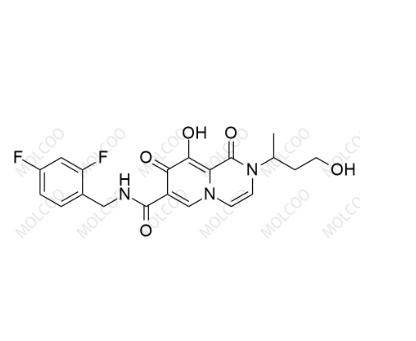
Product Number: D021033
English Name: Dolutegravir Impurity 33
English Alias: N-(2,4-difluorobenzyl)-9-hydroxy-2-(4-hydroxybutan-2-yl)-1,8-dioxo-2,8-dihydro-1H-pyrido[1,2-a]pyrazine-7-carboxamide
CAS Number: 2374716-73-9
Molecular Formula: C₂₀H₁₉F₂N₃O₅
Molecular Weight: 419.38
Product Advantages:
High purity and structural confirmation:HPLC purity ≥99.0%, confirmed by multiple methods including 1H NMR, 13C NMR, HRMS, and infrared spectroscopy, meeting the requirements of pharmacopoeias such as USP and EP for impurity reference standards.
Reliable stability:Stable for 36 months when stored at -20°C in the dark, with a degradation rate <1% after 14 days at room temperature in solution (e.g., methanol-water system), suitable for long-term quality monitoring and complex analytical scenarios.
Clear functional group characteristics:Contains hydroxyl, amide, and difluorobenzyl groups, enabling precise tracking of process risks from incomplete hydroxylation reactions or insufficient benzylation reagent selectivity in dolutegravir synthesis.
Applications:
Pharmaceutical impurity detection:Used for LC-MS/MS detection of Impurity 33 in dolutegravir APIs and formulations, controlling its content ≤0.1% in accordance with ICH Q3A standards to ensure compliance with strict quality requirements for anti-HIV drugs.
Synthesis process optimization:In benzylation and hydroxylation reactions, monitoring impurity content (e.g., reducing impurity from 1.1% to 0.1% when adjusting reaction pH from acidic to neutral) optimizes reaction conditions to reduce by-product formation.
Analytical method development:Serves as a multi-functional group impurity reference standard for establishing specific detection methods, such as ultra-performance liquid chromatography-diode array detection (UPLC-DAD), achieving accurate quantification using characteristic UV absorption (limit of quantitation LOQ=0.05μg/mL).
Toxicological research support:Provides samples for evaluating the potential toxicity of fluorinated impurities, facilitating in vitro cytotoxicity tests and in vivo pharmacokinetic studies to meet FDA requirements for impurity safety assessment in anti-AIDS drugs.
Background Description:
Dolutegravir Impurity 33 is a multi-functional group impurity introduced during dolutegravir (an HIV integrase inhibitor) synthesis due to insufficient hydroxylation site selectivity or excessive benzylation reagents. The difluorobenzyl group in its structure may affect the drug's binding efficiency to integrase, while incomplete hydroxyl reactions may increase metabolic product toxicity. According to the ICH M7(R1) guideline, organofluorine compounds require genotoxicity assessment, making strict control of this impurity a key aspect of dolutegravir quality research. Current industry standards set the individual impurity limit at ≤0.1% with reference to ICH Q3B.
Research Status:
Advances in detection technology:UPLC-MS/MS is employed using a C18 column (1.7μm, 2.1×100mm) with 0.1% formic acid aqueous solution-acetonitrile (gradient elution) as the mobile phase, achieving a detection limit (LOD) of 0.01ppm under multiple reaction monitoring (MRM) mode, suitable for quantitative analysis of trace fluorinated impurities.
Formation mechanism research:This impurity mainly originates from insufficient oxidant (e.g., hydrogen peroxide) dosage in hydroxylation reactions or non-selective substitution by benzylation reagents (e.g., 2,4-difluorobenzyl chloride). Increasing oxidant dosage (1.5equiv) and reacting at low temperature (0-5℃) can reduce impurity formation by over 80%.
Safety evaluation:In vitro HIV integrase inhibition tests show that the impurity has only 5% activity of the parent drug, but mild hepatic mitochondrial damage was observed in high-dose groups (200mg/kg) during a 28-day rat toxicity test, suggesting that reasonable limits (e.g., ≤0.08%) should be set based on toxicological data to ensure drug safety.





 China
China