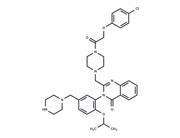
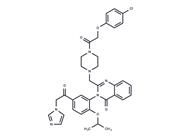
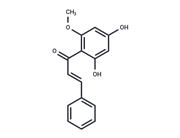
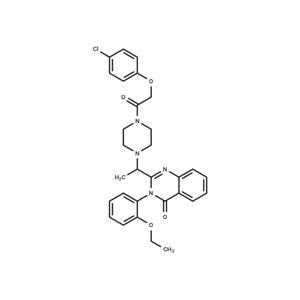
| Name | Erastin |
| Description | Erastin is an iron death activator that acts on the mitochondrial VDAC in a ROS- and iron-dependent manner. Erastin has anti-tumor activity and acts selectively on tumor cells with RAS-carcinogenic mutations. |
| Cell Research | BJeLR cells were plated at 100,000 cells/dish in 35 mm tissue culture dishes. After 12h cells were treated with vehicle (DMSO; 10 hrs), erastin (37 μM; 10 hrs), staurosporine (750 nM; 8 hrs), hydrogen peroxide (16 mM; 1 hr) or rapamycin (100 nM; 24 hrs). Cells were fixed with 2.5% glutaraldehyde in 0.1 M Sorenson's buffer (0.1 M H2PO4, 0.1 M HPO4 (pH 7.2)) for at least 1 h, and then treated with 1% OsO4 in 0.1 M Sorenson's buffer for 1 h. Enblock staining used 1% tannic acid. After dehydration through an ethanol series, cells were embedded in Lx-112 and Embed-812 (EMS). Thin sections were cut on an MT-7000 ultramicrotome, stained with 1% uranyl acetate and 0.4% lead citrate, and examined under a Jeol JEM-1200 EXII electron microscope. Pictures were taken on an ORCA-HR digital camera at 5,000-50,000-fold magnification [1]. |
| Animal Research | Tumor growth studies were performed in severe combined immunodeficient (SCID) mice xenograft model. Briefly, 2×10^6 viable HT-29 cells in 100 μL of growth medium (per mouse) were subcutaneously inoculated, and mice bearing ~100 mm3 tumors were randomly divided into three groups with 10 mice per group. Mice were treated daily with 10 or 30 mg/kg body weight of erastin (intraperitoneal injection, for 4 weeks) or vehicle control (Saline). Tumor volumes were calculated by the modified ellipsoid formula: (π / 6) ×AB2, where A is the longest and B is the shortest perpendicular axis of a tumor mass. Mice body weights were also recorded every week. Humane endpoints were always utilized to minimize mice suffering. Animals were observed on daily bases. Signs such as significant-reduced locomotion, severe diarrhea, severe piloerection or a sudden weight loss (> 20%) were recorded. If animals reached these endpoints they were euthanized by exsanguination under 2,2,2-tribromoethanol anesthesia (4 mg/10 g body weight). All injections were performed under the 2,2,2-tribromoethanol anesthesia method [3]. |
| In vitro | METHODS: Human gastric cancer cells HGC-27 were treated with Erastin (1-50 μM) for 24 h, and cell growth inhibition was detected by CCK-8.
RESULTS: Erastin dose-dependently inhibited HGC-27 cell growth with an IC50 of approximately 14.39 μM. [1]
METHODS: Human melanoma cells A375 were treated with Erastin (2-10 μM) for 3-12 h. The expression levels of target proteins were detected by Western Blot.
RESULTS: Erastin treatment caused a significant down-regulation of VDAC2 and VDAC3, and a slight decrease of VDAC1 in A375 cells. [2]
METHODS: Human colon cancer cells HT-29 were treated with Erastin (0.1-30 μM) for 12 h. The intracellular ROS levels were measured by Flow Cytometry.
RESULTS: Erastin treatment significantly increased ROS levels in HT-29 cells. [3] |
| In vivo | METHODS: To test the antitumor activity in vivo, erastin (20 mg/kg in 20 μL DMSO plus 130 μL corn oil) was intraperitoneally injected into NSG mice bearing human prostate cancer tumors DU145, ARCaP, PC3, or H660 once daily for two to five weeks.
RESULTS: Erastin treatment significantly inhibited the growth of human prostate cancer tumors, indicating antitumor activity in vivo. [4]
METHODS: To study the effect of erastin treatment on anticancer radiation efficiency, erastin (15 mg/kg in 5% DMSO/corn oil) was injected intraperitoneally into BALB/c Slc-nu/nu mice bearing human lung adenocarcinoma tumor NCI-H1975 once a day for three days. Twenty-four hours after the last erastin injection, the anesthetized mice were locally irradiated with 3 Gy X-rays.
RESULTS: Erastin-treated NCI-H1975 cell transplanted mice showed a trend of sensitization to X-ray irradiation with a concomitant decrease in intra-tumoral glutathione concentration. [5] |
| Storage | Powder: -20°C for 3 years | Shipping with blue ice/Shipping at ambient temperature. |
| Solubility Information | DMSO : 25 mg/mL (45.7 mM), Sonication is recommended.
Ethanol : < 1 mg/mL (insoluble or slightly soluble)
10% DMSO+40% PEG300+5% Tween 80+45% Saline : 1.6 mg/mL (2.92 mM), Solution.
20% Cremophor EL : 10 mg/mL (18.28 mM), Suspension.
H2O : < 1 mg/mL (insoluble or slightly soluble)
|
| Keywords | Voltage-dependent anion channel | VDAC | Inhibitor | inhibit | Ferroptosis | Erastin |
| Inhibitors Related | Rosiglitazone | Hemin | Acetylcysteine | L-Glutamic acid | Sorafenib | Curcumin | L-Cystine | L-Glutamine | (-)-Epigallocatechin Gallate | Coenzyme Q10 | Baicalein | Sodium Molybdate |


 United States