| In vitro | A simplified protocol for staining cortical neurons with the calcium dye fura-2 is as follows:
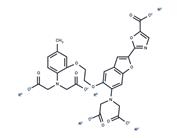
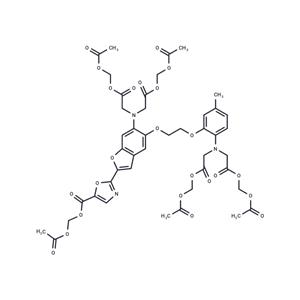
Cells are loaded with the acetoxymethyl ester of fura-2 (fura-2 AM), which diffuses across the cell membrane and is deesterified by cellular esterases to produce the free acid fura-2. The exact parameters for fura-2 loading vary depending on the cell type. It is recommended to test various conditions by preparing several loading solutions containing various concentrations of fura-2, ranging from 1–4 μM. Cells are incubated in the loading solutions for varying times, ranging from 15 minutes to 2 hours, and the loading volume is tested at both room temperature and 37°C.
1. First, prepare a 1 mM stock solution of fura-2 AM by adding 50 μl of DMSO to a 50 μg vial provided by Invitrogen. It is important to use dry DMSO packaged under nitrogen, and it is necessary to remove the DMSO with a needle by piercing the septum to prevent hydration of the DMSO. After preparing the fura-2 AM solution, store it in a dark, dry place. Fura-2 AM in DMSO is stable for 24 hours at room temperature and for several months at -20°C in a dry container.
2. Aliquot 2 ml of culture medium into 15 ml conical tubes, warm to 37°C, and then add 2 μl of Fura-2 AM stock solution to create a 1 μM Fura-2 AM solution. Vortex the solution vigorously for 1 minute.
3. Transfer the loading solution to a 35 mm tissue culture dish and transfer the coverslip with cells to the dish.
4. Incubate the neurons at 37°C in a dark incubator for 30 minutes. Time the incubation period precisely.
5. Prepare a 35 mm dish containing 2 ml of tissue culture medium without Fura-2 AM. Remove the coverslip from the loading solution and place it in a new dish.
6. Mount the coverslip on the imaging chamber. Remove the coverslip from the 35 mm dish and quickly mount it on the chamber, making sure to prevent the cells from drying out. We used an imaging chamber manufactured by Warner Instruments that allows a 10 mm coverslip containing the cells to be mounted on the bottom and a second coverslip to be mounted on the top, forming a sandwich. The two coverslips are secured to the chamber with vacuum grease, and two tubes at either end of the chamber allow solutions to be perfused through the chamber. The input line is connected to a syringe, and the output line is connected to a well, which is evacuated by a suction tube connected to a vacuum trap. [3]
The above information is based on published literature. Experimental procedures should be appropriately modified to meet specific research demands. |


 United States