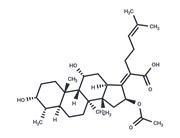
| Name | Fusidic acid sodium salt |
| Description | Fusidic acid sodium salt (SQ-16360) is a sodium salt form of fusidic acid, a bacteriostatic antibiotic derived from the fungus Fusidium coccineum and used as a topical medication to treat skin infections. |
| Kinase Assay | Binding assays: Binding assays are performed as previously described (Allenby et al., 1993, 1994). Briefly, labeled and unlabeled retinoids are added to nucleosol or cytosolic fractions in ethanol so that the total amount of ethanol added is constant in all tubes and did not exceed 2% of the incubation volume. The receptor preparations are incubated with retinoids at 4°C for 4–6 hr. Sephadex PD-10 desalting columns are used to separate bound radioligand from free radioligand after equilib- rium is achieved. For competitive binding assays, varying concentrations of unlabeled competing ligand are incubated with the appropriate nucleosol or cytosol in the presence of a fixed concentration of [3H]tRA (sp. act. 49.3 Ci/mmol) or [3H]9-cis RA (sp. act. 24.0 Ci/mmol). Final concentrations of [3H] tRA and [3H]9-cis RA for nuclear receptor binding assays are 5 nM. Final concentrations of [3H] tRA for CRABP binding assays is 30 nM. The IC50s are calculated as described above (DeLean et al., 1978). For saturation kinetics, increasing concentrations of radiolabeled ligand ([3H]tRA sp. act. 49.3 Ci/mmol, [3H]TTNPB sp. act. 5.5 Ci/ mmol) are added to the nucleosol of the appropriate receptor subtype in the presence (nonspecific binding) or absence (total binding) of a 100-fold molar excess of the corresponding unlabeled retinoid. Specific binding is defined as the total binding minus nonspecific binding. Saturation kinetics are calculated as previously described (Scatchard, 1949; Grippo and Gudas, 1987; Levin et al., 1992). |
| In vivo | Fusidin(Fusidate Sodium) ameliorates EAM, at least partly, through an inhibitory action on the secretion of TNF-a[1]. It markedly attenuates clinical and histological signs of immunoinflammatory diabetes mellitus in mice given streptozotocin(SZ). The effect is dose-dependent, observed in three different strains of mice. Thus, fusidin might have an antidiabetogenic effect[2]. |
| Storage | Powder: -20°C for 3 years | In solvent: -80°C for 1 year | Shipping with blue ice/Shipping at ambient temperature. |
| Solubility Information | Ethanol : 93 mg/mL (172.64 mM), Sonication is recommended.
H2O : 92 mg/mL (170.78 mM), Sonication is recommended.
10% DMSO+40% PEG300+5% Tween 80+45% Saline : 3.3 mg/mL (6.13 mM), Sonication is recommended.
DMSO : 93 mg/mL (172.64 mM), Sonication is recommended.
|
| Keywords | steroids | SQ16360 | SQ 16360 | ribosome | Inhibitor | inhibit | growth | Fusidic acid sodium salt | Fusidic acid sodium | Fusidic acid | factor | elongation factor G (EF-G) | elongation | CAT | bacteriostatic | Bacterial | Antibiotic |
| Inhibitors Related | Neomycin sulfate | Adipic dihydrazide | Levulinic acid | D(+)-Raffinose pentahydrate | Sulfamethoxazole sodium | Terbinafine hydrochloride | Hydroxypropyl Cellulose | Doxycycline | Hyaluronic acid sodium (MW 20 kDa) | Dimethyl sulfoxide | Gluconate Calcium | Sodium diacetate |
| Related Compound Libraries | Bioactive Compound Library | Pediatric Drug Library | Approved Drug Library | Drug-induced Liver Injury (DILI) Compound Library | Toxic Compound Library | Drug Repurposing Compound Library | Microbial Natural Product Library | Inhibitor Library | NO PAINS Compound Library | Immunology/Inflammation Compound Library | Bioactive Compounds Library Max | Oxidation-Reduction Compound Library |



 United States