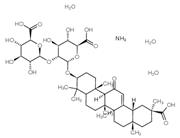
Glycyrrhizic acid ammonium salt
Modify Date: 2024-01-02 18:57:07
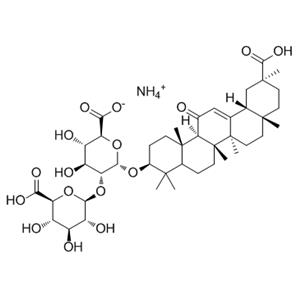
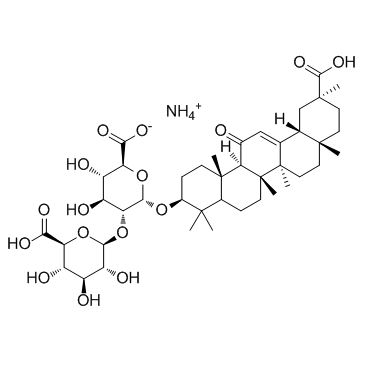 Glycyrrhizic acid ammonium salt structure | Common Name | Glycyrrhizic acid ammonium salt |
|---|
| CAS Number | 53956-04-0 | Molecular Weight | 839.96 |
|---|
| Density | 1.43g/cm3 | Boiling Point | 971.4ºC at 760mmHg |
|---|
| Molecular Formula | C42H65NO16 | Melting Point | 209ºC |
|---|
| MSDS | ChineseUSA | Flash Point | 288.1ºC |
|---|
|
|
|
|
|
|
|
|
Use of Glycyrrhizic acid ammonium salt
Monoammonium glycyrrhizinate hydrate has various pharmacological actions such as anti-inflammatory, antiallergic, antigastriculcer, and antihepatitis activities. |
Properties
Articles41
Spectrum
Names
| Name | Glycyrrhizic acid ammonium salt |
|---|
| Synonym | More Synonyms |
|---|
Glycyrrhizic acid ammonium salt Biological Activity
| Description | Monoammonium glycyrrhizinate hydrate has various pharmacological actions such as anti-inflammatory, antiallergic, antigastriculcer, and antihepatitis activities. |
|---|
| Related Catalog | Signaling Pathways >> Others >> Others Research Areas >> Inflammation/Immunology |
|---|
| In Vivo | The increase of the lung W/D weight ratios is significantly reduced by high and medium dose of MAG (10 and 30mg/kg) administration. Pretreatment with MAG (10 and 30mg/kg) efficiently reduces the production of TNF-α and IL-1β. MAG (10, 30mg/kg) significantly decreases NF-κB p65 protein expression, compared with LPS. On the contrary, LPS significantly reduces IκB-α protein expression compared with the control group, whereas MAG (10 and 30mg/kg) significantly increased IκB-α expression, compared with the LPS group[1]. Low- and high-dose MAG treatment significantly reduces the AST, ALT, TBIL, and TBA levels at 14 and 21 d time points when compared with that of the RIF and INH group, suggesting the protective effect of MAG on RIF- and INH-induced liver injury. MAG treatment groups elevate the hepatic GSH level at 7, 14, and 21 d time points and markedly reduce the MDA level at 14 and 21 d time points in RIF- and INH-treated rats, suggesting the protective effect of MAG in RIF- and INH induced liver injuries[2]. |
|---|
| Animal Admin | Mice[1] In this study, BALB/c mice (male, 6-8weeks old, and 20-25 g) are used. Mice are randomly divided into five groups: control group, LPS group, and LPS + Monoammonium glycyrrhizinate (MAG: 3, 10, and 30mg/kg) groups. Each group contains eight mice. Mice are anesthetized with intraperitoneal injection of sodium pentobarbital (50mg/kg). Before inducing acute lung injury, the mice are given intraperitoneal injection with MAG (3, 10, and 30mg/kg). One hour later, LPS (5mg/kg) is instilled intratracheally to induce acute lung injury. Normal mice are given PBS[1]. Rats[2] Male Wistar rats (180-220 g) are used. Rats are randomly divided into four groups, i.e., control group, RIF and INH group, MAG low-dose group, and MAG high-dose group, each group has 15 rats. Rats in the RIF and INH group receive RIF (60 mg/kg) and INH (60 mg/kg) by gavage administration once daily; rats in MAG groups are pretreated with MAG at the doses of 45 or 90 mg/kg, RIF (60 mg/kg) and INH (60 mg/kg) are given 3 h after MAG administration; rats in the control group are treated with saline. To evaluate the dynamic effect of drugs, rats in each group are sacrificed on 7, 14, and 21 d after drug administration[2]. |
|---|
| References | [1]. Huang X, et al. Anti-Inflammatory Effects of Monoammonium Glycyrrhizinate on Lipopolysaccharide-Induced Acute Lung Injury in Mice through Regulating Nuclear Factor-Kappa B Signaling Pathway. Evid Based Complement Alternat Med. 2015;2015:272474. [2]. Zhou L, et al. Monoammonium glycyrrhizinate protects rifampicin- and isoniazid-induced hepatotoxicity via regulating the expression of transporter Mrp2, Ntcp, and Oatp1a4 in liver. Pharm Biol. 2016;54(6):931-7. |
|---|
Chemical & Physical Properties
| Density | 1.43g/cm3 |
|---|
| Boiling Point | 971.4ºC at 760mmHg |
|---|
| Melting Point | 209ºC |
|---|
| Molecular Formula | C42H65NO16 |
|---|
| Molecular Weight | 839.96 |
|---|
| Flash Point | 288.1ºC |
|---|
| PSA | 272.70000 |
|---|
| LogP | 0.32860 |
|---|
| Index of Refraction | 49 ° (C=1.5, EtOH) |
|---|
| Storage condition | 2-8°C |
|---|
| Water Solubility | Slightly soluble in water, very slightly soluble in anhydrous ethanol, practically insoluble in acetone. It dissolves in dilute solutions of acids and of alkali hydroxides. |
|---|
MSDS
Glycyrrhizic acid ammonium salt MSDS(Chinese) |
Toxicological Information
CHEMICAL IDENTIFICATIONCHEMICAL NAME : alpha-D-Glucopyranosiduronic acid, (3-beta,20-beta)-20-carboxy-11-oxo-30-norolean-12-en- 3-yl 2-O-beta-D-glucopyranuronosyl-, ammoniate
CAS REGISTRY NUMBER : 53956-04-0
MOLECULAR FORMULA : C42-H62-O16.H3-N
HEALTH HAZARD DATAACUTE TOXICITY DATASPECIES OBSERVED : Rodent - rat
ROUTE OF EXPOSURE : Intraperitoneal
SPECIES OBSERVED : Rodent - rat
DOSE/DURATION : >300 mg/kg
SPECIES OBSERVED : Rodent - mouse
DOSE/DURATION : 9818 mg/kg
ROUTE OF EXPOSURE : Intraperitoneal
SPECIES OBSERVED : Rodent - mouse
ROUTE OF EXPOSURE : Intravenous
SPECIES OBSERVED : Rodent - mouse
SPECIES OBSERVED : Rodent - rat
DOSE/DURATION : 224 mg/kg/26W-C
SPECIES OBSERVED : Rodent - rat
DOSE/DURATION : 840 mg/kg/30D-I
TOXIC EFFECTS : Liver - hepatitis (hepatocellular necrosis), diffuse Blood - changes in leukocyte (WBC) count Biochemical - Enzyme inhibition, induction, or change in blood or tissue levels - phosphatases
TYPE OF TEST : Dominant lethal test
MUTATION DATATEST SYSTEM : Rodent - mouse
REFERENCE : NTIS** National Technical Information Service. (Springfield, VA 22161) Formerly U.S. Clearinghouse for Scientific & Technical Information. Volume(issue)/page/year: PB279-650 *** NIOSH STANDARDS DEVELOPMENT AND SURVEILLANCE DATA *** NIOSH OCCUPATIONAL EXPOSURE SURVEY DATA : NOES - National Occupational Exposure Survey (1983) NOES Hazard Code - X5765 No. of Facilities: 3 (estimated) No. of Industries: 1 No. of Occupations: 2 No. of Employees: 221 (estimated) No. of Female Employees: 144 (estimated)
|
Safety Information
| Personal Protective Equipment | Eyeshields;Gloves;type N95 (US);type P1 (EN143) respirator filter |
|---|
| Hazard Codes | Xn |
|---|
| RIDADR | UN 3077 9 / PGIII |
|---|
| WGK Germany | 2 |
|---|
| RTECS | LZ6500000 |
|---|
Company Profile
Our company is a high-tech enterprise specializing in chemical raw materials such as electronic materials, optoelectronic materials, semiconductor materials, UV monomers, silane catalysts, cosmetic raw materials, etc. The company integrates research and development, production, customized synthesis, and sales, and is committed to providing customers with high-quality chemical product solutions.
Our Company


Our Advantage
Rich experience
Our products have been exported to many countries, including Germany, Spain, the United Kingdom, the United States, Australia, the Middle East, Asia, and more. We have received highly positive feedback from our clients and have established long-term friendly cooperative relationships with them.
Excellent quality, purity, and competitive price
Excellent quality is one of the cornerstones of our success. We welcome ordering samples for quality testing.

Safe and fast delivery
We will arrange shipment of spot products as soon as we receive payment.
Customized products are determined based on the synthesis time of different products.
Excellent pre-sales and after-sales service
Pre sales:
We are committed to providing the most favorable quotes and detailed information about our products and company.
after-sale service:
We assist buyers in customs clearance by providing necessary documents and information.
If there is any dispute over product quality, we are committed to providing the best solution.
• Packaging:
1kg/bag, 25kg/drum, 50kg/drum, 180kg/drum, 200kg/drum, 1T/bag/drum, standard export packaging or packaging required by customers


• Shipping

• Delivery:
Within 7 days after receiving your payment
Contact information
For more details, pls contact us freely.
Contact name: Tina
Email address: Tina@fdachem.com
Mob: 86 13213167925
WhatsApp/Skype/Wechat/LINE: 86 15225627621



 China
China