Human Glypican 4 / GPC4 Protein, His Tag (MALS verified)
Synonym
Glypican 4, glypican proteoglycan 4, glypican-4, GPC4, K-glypican
Source
Human Glypican 4, His Tag (GP4-H52H3) is expressed from human 293 cells (HEK293). It contains AA Ala 19 - Ser 529 (Accession # O75487-1).
Molecular Characterization

This protein carries a polyhistidine tag at the C-terminus.
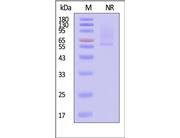
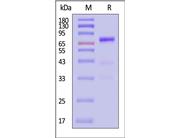
The protein has a calculated MW of 59.5 kDa. The protein migrates as 60-65 kDa under non-reducing (NR) condition (SDS-PAGE) due to glycosylation.
Endotoxin
Less than 1.0 EU per μg by the LAL method / rFC method.
Purity
>90% as determined by SDS-PAGE.
>90% as determined by SEC-MALS.
Formulation
Lyophilized from 0.22 μm filtered solution in PBS, pH7.4 with trehalose as protectant.
Contact us for customized product form or formulation.
Reconstitution
Please see Certificate of Analysis for specific instructions.
For best performance, we strongly recommend you to follow the reconstitution protocol provided in the CoA.
Storage
For long term storage, the product should be stored at lyophilized state at -20°C or lower.
Please avoid repeated freeze-thaw cycles.
This product is stable after storage at:
-20°C to -70°C for 12 months in lyophilized state;
-70°C for 3 months under sterile conditions after reconstitution.
Background
Glypican-4 is a protein that in humans is encoded by the GPC4 gene. Cell surface heparan sulfate proteoglycans are composed of a membrane-associated protein core substituted with a variable number of heparan sulfate chains. Members of the glypican-related integral membrane proteoglycan family contain a core protein anchored to the cytoplasmic membrane via a glycosyl phosphatidylinositol linkage. These proteins may play a role in the control of cell division and growth regulation. The GPC4 gene is adjacent to the 3' end of GPC3 and may also play a role in Simpson-Golabi-Behmel syndrome.




 China
China