GMP Human IFN-gamma Protein
GMP Platform Advantages
1. Quality Assurance: Global QMS with comprehensive and stringent QC release criteria.
2. End-to-End GMP Compliance: Full manufacturing and QC under a cGMP system.
3. Comprehensive Control of Adventitious Agents: Stringent biosafety from cell banks to final release.
4. Comprehensive Regulatory Support: Includes RSF and DMF to meet global requirements.
5. Resilient Supply Chain: Intelligent modular facilities ensure a stable global supply.
6. Professional Support: Extensive manufacturing and application expertise to accelerate development.
Source
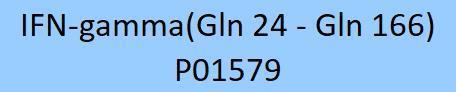
GMP Human IFN-gamma Protein (GMP-IFGH24) is expressed from human 293 cells (HEK293). It contains AA Gln 24 - Gln 166 (Accession # P01579).
Predicted N-terminus: Gln 24
Molecular Characterization
This protein carries no "tag".
The protein has a calculated MW of 16.8 kDa. The protein migrates as 15 kDa, 19 kDa and 24 kDa±3 kDa under reducing (R) condition (SDS-PAGE) due to glycosylation.
Endotoxin
Less than 10 EU/mg, tested by the LAL method in compliance with USP <85> and Ph. Eur. 2.6.14.
Host Cell Protein
<0.5 ng/µg of protein tested by ELISA.
Host Cell DNA
<0.02 ng/μg of protein tested by qPCR.
Sterility
Sterility testing was performed using the membrane filtration method in compliance with USP <71> and Ph. Eur. 2.6.1.
Mycoplasma
Negative
Purity
>95% as determined by SDS-PAGE.
Formulation
Lyophilized from 0.22 μm filtered solution in PBS, pH7.4 with protectants.
Contact us for customized product form or formulation.
Vial Specification
2R (13 mm neck finish)
Shipping
This product is supplied and shipped with blue ice, please inquire the shipping cost.
Storage
Upon receipt, store it immediately at -20°C or lower for long term storage.
Please avoid repeated freeze-thaw cycles.
This product is stable after storage at:
-20°C to -70°C for 5 years in lyophilized state;
-70°C for 12 months under sterile conditions after reconstitution.
Background
Interferon-gamma (IFN-γ/IFNG) is a dimerized soluble cytokine that is the only member of the type II class of interferon. This interferon was originally called macrophage-activating factor, a term now used to describe a larger family of proteins to which IFN-γ belongs. IFN-gamma has been used in a wide variety of clinical indications. Interferon-gamma (IFNgamma) is a central regulator of the immune response and signals via the Janus Activated Kinase (JAK)-Signal Transducer and Activator of Transcription (STAT) pathway. Interferon gamma has broader roles in activation of innate and adaptive immune responses to viruses and tumors, in part through upregulating transcription of genes involved in cell cycle regulation, apoptosis, and antigen processing/presentation. Despite this, rodent and human trophoblast cells show dampened responses to IFNG that reflect the resistance of these cells to IFNG-mediated activation of major histocompatibility complex (MHC) class II transplantation antigen expression.



 China
China