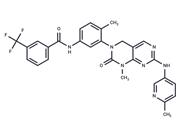
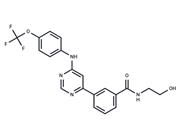
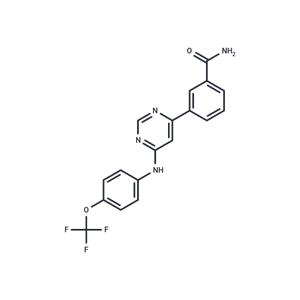
| Name | GNF-2 |
| Description | GNF-2 is a highly selective non-ATP competitive inhibitor of Bcr-Abl. |
| Cell Research | Cells (0.3-0.6 × 10⁶ per mL) are plated in duplicate or triplicate in 96-well plates containing increasing GNF-2 concentrations (5 nM–10 μM). After incubation at 37 ℃ in 5% CO2 for 48 hours, the effect of GNF-2 on cell viability is determined by the MTT colorimetric dye reduction method. Inhibition of cell proliferation is calculated as a percentage of growth of DMSO-treated cells, and IC50 values are determined with Microsoft Excel XLfit3.(Only for Reference) |
| Kinase Assay | Binding assay: Recombinant proteins (100 nM for each construct) or immunoprecipitated proteins are diluted in kinase buffer (20 mM HEPES (pH 7.4), 50 mM KCl, 0.1% CHAPS, 30 mM MgCl2, 2 mM MnCl2, 1 mM DTT, and 1% glycerol). Aliquots of the diluted proteins are preincubated with either DMSO or compounds for 30 min at room temperature and then added to K-LISA PTK EAY reaction plates. The kinase reaction is initiated by adding 0.1 mM ATP and is allowed to proceed for 30 min at room temperature. The phosphorylation of GST-Abltide is monitored by SDS-PAGE and phosphorimaging analysis or autoradiography. |
| In vivo | GNF-2, at a concentration of 1 μM, induces apoptosis in Ba/F3.p210 and Ba/F3.p210E255V cells and significantly reduces phosphorylated Stat5 levels in Ba/F3.p210 cells. It inhibits Bcr-abl tyrosine phosphorylation in a dose-dependent manner, with an IC50 value of 267 nM. Furthermore, 10 μM GNF-2 inhibits BCR-Abl-dependent cell proliferation, requiring the BCR and/or c-Abl SH3 and/or SH2 domains, and significantly suppresses CrkII tyrosine phosphorylation in a dose-dependent manner. GNF-2 demonstrates an inhibition effect on CrkII phosphorylation in cells expressing c-AblG2A, with an IC50 of 0.051 μM, and inhibits autophosphorylation and proliferation in cells expressing p210Bcr-Abl and its mutants, BafF3. When combined with GNF-5 (20 nM), GNF-2 (8 nM) shows a synergistic effect in inhibiting Abl64-515 kinase activity. It also exhibits dose-dependent inhibitory effects on the growth of Bcr-abl positive cells (IC50 values: 273 nM for K562 and 268 nM for SUP-B15) and Ba/F3.p210E255V and Ba/F3.p185Y253H cells, with IC50 values of 268 nM and 194 nM, respectively. |
| Storage | Powder: -20°C for 3 years | In solvent: -80°C for 1 year | Shipping with blue ice/Shipping at ambient temperature. |
| Solubility Information | DMSO : 37.4 mg/mL (99.91 mM), Sonication is recommended.
10% DMSO+40% PEG300+5% Tween 80+45% Saline : 2 mg/mL (5.34 mM), Sonication is recommended.
Ethanol : 18.7 mg/mL (49.96 mM), Sonication is recommended.
|
| Keywords | SARS-CoV | SARSCoV | SARS coronavirus | non-ATP competitive inhibitor | Inhibitor | inhibit | GNF-2 | GNF 2 | bone erosion | Bcr-Abl (SUP-B15 cell line) | Bcr-Abl (K562 cell line) | Bcr-Abl | BcrAbl | Ba/F3.p210E255V | Ba/F3.p210 | Ba/F3.p185Y253H | allosteric |
| Inhibitors Related | EIDD-1931 | Remdesivir | Molnupiravir | Silymarin | Umifenovir hydrochloride | Hydroxychloroquine | Ritonavir | Chloroquine phosphate | Dasatinib | Dexamethasone acetate | α-Cyclodextrin | Dexamethasone |
| Related Compound Libraries | Highly Selective Inhibitor Library | Bioactive Compound Library | Membrane Protein-targeted Compound Library | Kinase Inhibitor Library | Tyrosine Kinase Inhibitor Library | Anti-Cancer Metabolism Compound Library | Hematonosis Compound Library | Anti-Viral Compound Library | Angiogenesis related Compound Library | Inhibitor Library | Bioactive Compounds Library Max | Anti-Infection Compound Library |


 United States