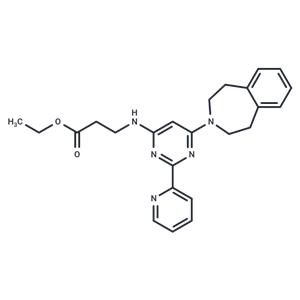
| Name | GSK-J4 |
| Description | GSK-J4 (GSK J4 HCl) is a cell permeable prodrug of GSK-J1, a dual inhibitor of the H3K27me3/me2 demethylases JMJD3/KDM6B and UTX/KDM6A (IC50=8.6/6.6 μM). GSK-J4 induces endoplasmic reticulum stress-related apoptosis. |
| Animal Research | GSK-J4 is prepared in DMSO and diluted 1/10 with ethanol.Six-to eight-week-old female C57BL/6 WT mice are injected by subcutaneous injection (s.c.) with 50 μg myelin oligodendrocyte glycoprotein 35-55 peptide (pMOG) emulsified in Complete Freund's Adjuvant (CFA) supplemented with heat-inactivated Mycobacterium tuberculosis H37 RA. In addition, mice receive intraperitoneal injection (i.p.) of 500 ng of pertussis toxin on days 0 and 2. Clinical signs are assessed daily according to the following scoring criteria: 0, no detectable signs; 1, flaccid tail; 2, hind limb weakness or abnormal gait; 3, complete hind limb paralysis; 4, paralysis of fore and hind limbs; and 5, moribund or death. A stock solution of GSK-J4 of 42 mg/mL (100 mM) is prepared in dimethyl sulfoxide (DMSO) to preserve stability. Before injection, the stock solution is diluted 1/10 with ethanol (DMSO: ethanol, 1:10 v/v) and brought to a final concentration of 140 μg/mL in PBS. In systemic drug evaluation experiments, each mouse receive daily i.p. injections (from days 0-5) of 100 μL of this solution containing 14.0 μg of the GSK-J4 (equivalent to 0.56 mg/kg of the drug). Control mice receive 100 μL of the vehicle during the same period. In other EAE experiments, 106 bone marrow-derived DCs from WT mice are treated with GSK-J4 or vehicle alone for 16 h, pulsed with 5 μg/mL of pMOG for 4 h and then transferred i.v. into WT C57BL/6 recipient mice 14 and 7 days before EAE induction. In other adoptive transfer EAE experiments, CD4+Foxp3+ Treg cells generated in the presence or absence of 25 nM GSK-J4 are purified by cell sorting and then 0.75×10⁶ transferred i.v. into WT C57BL/6 recipient mice 1 day before EAE induction. |
| In vitro | METHODS: Prostate cancer cell lines R1-AD1, R1-D567, R1-I567, CWR22Rv-1 and PC3 were treated with GSK-J4 (0-32 µM) for 72 h. Cell viability was measured by Alamar blue reagent.
RESULTS: GSK-J4 had cell growth inhibitory and/or cytotoxic effects on PC cells. cWR22Rv-1 was the most sensitive to the treatment, with an ED50 of about 3 µM.[1]
METHODS: Human acute myeloid leukemia cells KG-1a were treated with GSK-J4 (2-10 µM) for 48 h. Apoptosis was detected by Flow cytometry.
RESULTS: The apoptosis rate of KG-1a cells in the GSK-J4 treatment group was significantly increased compared with the control group. [2] |
| In vivo | METHODS: To investigate the effect on sepsis, GSK-J4 (1-3 mg/kg) was administered intraperitoneally to ICR mice, and sepsis was induced by injection of bacterial suspension 1 h later.
RESULTS: Pharmacological inhibition of JMJD3 by GSKJ4 protected mice from early septic death and reduced the production of the pro-inflammatory cytokine IL-1β and the expression of IL-6, TNF-α and MCP-1. [3] |
| Storage | Powder: -20°C for 3 years | In solvent: -80°C for 1 year
Shipping with blue ice/Shipping at ambient temperature. |
| Solubility Information | Ethanol : 41.75 mg/mL (100 mM), Sonication is recommended.
10% DMSO+40% PEG300+5% Tween 80+45% Saline : 4.18 mg/mL (10.01 mM), Solution.
DMSO : 141 mg/mL (337.72 mM), Sonication is recommended.
|
| Keywords | Th17 | Th1 | TGF-β | JMJD3 | HistoneDemethylase | Histone Demethylase | H3K27me3/me2 | GSK-J-4 | GSK-J4 | GSKJ4 | dendritic | demethylase | Apoptosis |
| Inhibitors Related | Stavudine | Aceglutamide | Urea | Tamoxifen | Cysteamine hydrochloride | Metronidazole | Citric Acid Triammonium | Formamide | Dimethyl phthalate | Alginic acid | Sodium Molybdate | Sildenafil citrate |
| Related Compound Libraries | Apoptosis Compound Library | Histone Modification Compound Library | Methylation Compound Library | Bioactive Compound Library | Endoplasmic Reticulum Stress Compound Library | Epigenetics Compound Library | Chromatin Modification Compound Library | Post-Translational Modification Compound Library | Inhibitor Library | NO PAINS Compound Library | Bioactive Compounds Library Max | Anti-Cancer Compound Library |


 United States