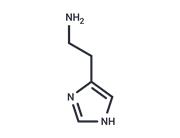
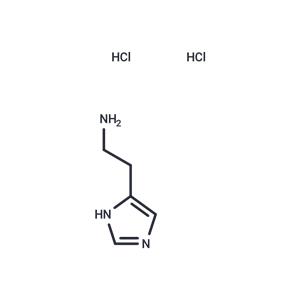
| Name | Histamine dihydrochloride |
| Description | Histamine dihydrochloride (Ceplene) is the dihydrochloride salt form of histamine, an endogenous metabolic product. Histamine is an organic nitrogen-containing compound with diverse biological activities. It acts as a potent stimulator of gastric acid secretion, a bronchial smooth muscle constrictor, and a vasodilator, as well as a neurotransmitter with central nervous system activity. It is commonly used to induce gastric ulcer models in research. |
| In vitro | Histamine suppresses the generation of ROS through the Histaminetype-2 receptor (H2 receptor).[1] Histamine inhibits the generation and release of reactive oxygen species (ROS) by monocytes/macrophages (MO) during respiratory burst. Histamine and interleukin-2 (IL-2) act synergistically to activate NK cell cytotoxicity (NKCC). Histamine combined with IL-2 might improve response rates and disease-free survival by protecting the cells of the immune system from oxidative stress and inducing natural endogenous immune cytotoxicity. [2] |
| In vivo | Histamine treatment (0.5 mg/kg or 5.0 mg/kg, twice daily) protects against liver injury as evident by normal serum transaminase levels and significantly reduced liver pathology scores in a rat model with early alcohol-induced liver injury. The protective effect of histamine is blocked by Ranitidine (10 mg/kg), an H2 receptor antagonist, indicating that the histamine effect is predominantly mediated through the H2 receptor. [1] Histamine (30 pg/rat, icv) increases both 3,4-dihydroxyphenylalanine accumulation and 3,4-dihydroxyphenylalanine acid concentrations in the nucleus accumbens in male rats, and this effect is not affect by H2 antagonist zolantidine, indicating that histamine stimulates mesolimbic DA neurons through an action at the H1 receptor. [3] Histamine (0.5 mg/kg s.c.) reduces the liver tumour weight by 46% and subcutaneous tumour weight by 41% versus rats receiving subcutaneous saline injections. The anti-tumour effect observed by subcutaneous histamine injections is inhibited by Ranitidine (50 mg/kg s.c.) in rats sarcoma. [4] Histamine (1000 mg/kg s.c.) displays acute tissue damage after 24 hours and indications of pathological inflammation at the injection sites at 5 days and 28 days in Sprague-Dawley rats. Histamine (1000 mg/kg s.c.) results in Cmax of 167 mM, tmax of 0.5 hour, t1/2 of 0.95 and AUC of 186 mmol-h/L in male Sprague-Dawley rats. [5] |
| Storage | Powder: -20°C for 3 years | In solvent: -80°C for 1 year
Pure form: -20°C for 3 years | In solvent: -80°C for 1 year
Shipping with blue ice/Shipping at ambient temperature. |
| Solubility Information | H2O : 18.4 mg/mL (99.96 mM), Sonication is recommended.
10% DMSO+40% PEG300+5% Tween 80+45% Saline : 2 mg/mL (10.87 mM), Sonication is recommended.
DMSO : 70 mg/mL (380.29 mM), Sonication is recommended.
|
| Keywords | Inhibitor | inhibit | HistamineReceptor | Histamine Receptor | Histamine dihydrochloride | Histamine | H2 receptor | H1 receptor | EndogenousMetabolite | Endogenous Metabolite |
| Inhibitors Related | Sucrose | Aceglutamide | Nicotinamide riboside malate | DL-Lysine | D(+)-Raffinose pentahydrate | Guanidine hydrochloride | Malic acid | Formamide | Glycerol | Thymidine | Corn starch | Gluconate Calcium |
| Related Compound Libraries | Bioactive Compound Library | Pain-Related Compound Library | Membrane Protein-targeted Compound Library | EMA Approved Drug Library | Natural Product Library | Drug Repurposing Compound Library | Natural Product Library for HTS | FDA-Approved Drug Library | Anti-Cancer Approved Drug Library | Anti-Aging Compound Library | GPCR Compound Library | Anti-Cancer Drug Library |


 United States