Human beta 2-Microglobulin / B2M Protein, His Tag
Synonym
B2M
Source
Human B2M, His Tag (B2M-H5225) is expressed from human 293 cells (HEK293). It contains AA Ile 21 - Met 119 (Accession # P61769-1).
Predicted N-terminus: Ile 21
Molecular Characterization

This protein carries a polyhistidine tag at the C-terminus.
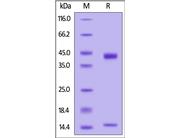
The protein has a calculated MW of 12.6 kDa. The protein migrates as 14 kDa when calibrated against Star Ribbon Pre-stained Protein Marker under reducing (R) condition (SDS-PAGE) due to glycosylation.
Endotoxin
Less than 1.0 EU per μg by the LAL method / rFC method.
Purity
>98% as determined by SDS-PAGE.
Formulation
Lyophilized from 0.22 μm filtered solution in PBS, pH7.4 with trehalose as protectant.
Contact us for customized product form or formulation.
Reconstitution
Please see Certificate of Analysis for specific instructions.
For best performance, we strongly recommend you to follow the reconstitution protocol provided in the CoA.
Storage
For long term storage, the product should be stored at lyophilized state at -20°C or lower.
Please avoid repeated freeze-thaw cycles.
This product is stable after storage at:
-20°C to -70°C for 12 months in lyophilized state;
-70°C for 3 months under sterile conditions after reconstitution.
Background
β2 microglobulin is also known as Beta-2-microglobulin (B2M), is a component of MHC class I molecules which belongs to the beta-2-microglobulin family. B2M is present on all nucleated cells (excludes red blood cells). B2M associates not only with the alpha chain of MHC class I molecules, but also with class I-like molecules such as CD1 and Qa. An additional function of B2M is association with the HFE protein, together regulating the expression of hepcidin in the liver which targets the iron transporter ferroportin on the cytoplasmic membrane of enterocytes and macrophages for degradation resulting in decreased iron uptake from food and iron release from recycled red blood cells respectively. Loss of this function causes iron excess and hemochromatosis. Defects in B2M are the cause of hypercatabolic hypoproteinemia (HYCATHYP).





 China
China