Biotinylated Human C1q R1 / CD93 Protein, His,Avitag™
Synonym
CD93, CDw93, C1QR1, MXRA4, C1qR, C1qR(P), C1qRP, ECSM3
Source
Biotinylated Human C1q R1, His,Avitag (C11-H82E9) is expressed from human 293 cells (HEK293). It contains AA Thr 22 - Lys 580 (Accession # Q9NPY3-1).
Predicted N-terminus: Thr 22
Molecular Characterization

This protein carries a polyhistidine tag at the C-terminus, followed by an Avi tag (Avitag™).
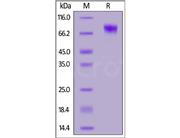
The protein has a calculated MW of 62.0 kDa. The protein migrates as 80-90 kDa under reducing (R) condition (SDS-PAGE) due to glycosylation.
Labeling
Biotinylation of this product is performed using Avitag™ technology. Briefly, the single lysine residue in the Avitag is enzymatically labeled with biotin.
Protein Ratio
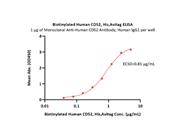
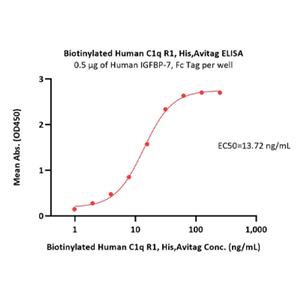
Passed as determined by the HABA assay / binding ELISA.
Purity
>95% as determined by SDS-PAGE.
Formulation
Lyophilized from 0.22 μm filtered solution in PBS, pH7.4 with trehalose as protectant.
Contact us for customized product form or formulation.
Reconstitution
Please see Certificate of Analysis for specific instructions.
For best performance, we strongly recommend you to follow the reconstitution protocol provided in the CoA.
Storage
For long term storage, the product should be stored at lyophilized state at -20°C or lower.
Please avoid repeated freeze-thaw cycles.
This product is stable after storage at:
-20°C to -70°C for 12 months in lyophilized state;
-70°C for 3 months under sterile conditions after reconstitution.
Background
CD antigen CD93 is also known as Complement component C1q receptor (C1QR1). which belongs to the Group XIV C-Type lectin family, a group containing two other members, endosialin (CD248) and thrombomodulin. CD93 contains one C-type lectin domain and five EGF-like domains. CD93 is highly expressed in endothelial cells, platelets, cells of myeloid origin, such as monocytes and neutrophils. CD93 is receptor for C1q, mannose-binding lectin (MBL2) and pulmonary surfactant protein A (SPA). CD93 may mediate the enhancement of phagocytosis in monocytes and macrophages upon interaction with soluble defense collagens and may play a role in intercellular adhesion.




 China
China