Synonym
EGFRvIII
Source
Human EGFRvIII, His Tag (EGI-H52H4) is expressed from human 293 cells (HEK293). It contains AA Leu 25 - Ser 378 (Accession # NP_001333870.1).
Predicted N-terminus: Leu 25
Request for sequence
Molecular Characterization

Other Tags and Version Biotin & Other Labeled Version
This protein carries a polyhistidine tag at the C-terminus.
The protein has a calculated MW of 40.5 kDa. The protein migrates as 55-80 kDa when calibrated against Star Ribbon Pre-stained Protein Marker under reducing (R) condition (SDS-PAGE) due to glycosylation.
Endotoxin
Less than 1.0 EU per μg by the LAL method / rFC method.
Purity
>95% as determined by SDS-PAGE.
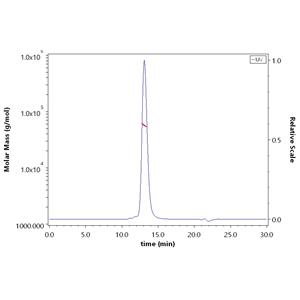
>95% as determined by SEC-MALS.
Formulation
Lyophilized from 0.22 μm filtered solution in PBS, pH7.4 with trehalose as protectant.
Contact us for customized product form or formulation.
Reconstitution
Please see Certificate of Analysis for specific instructions.
For best performance, we strongly recommend you to follow the reconstitution protocol provided in the CoA.
Storage
For long term storage, the product should be stored at lyophilized state at -20°C or lower.
Please avoid repeated freeze-thaw cycles.
This product is stable after storage at:
-20°C to -70°C for 12 months in lyophilized state;
-70°C for 3 months under sterile conditions after reconstitution.
Background
The epidermal growth factor receptor (EGFR; ErbB-1; HER1 in humans) is the cell-surface receptor for members of the epidermal growth factor family (EGF-family) of extracellular protein ligands. The epidermal growth factor receptor is a member of the ErbB family of receptors, a subfamily of four closely related receptor tyrosine kinases: EGFR (ErbB-1), HER2/c-neu (ErbB-2), Her 3 (ErbB-3) and Her 4 (ErbB-4). Mutations affecting EGFR expression or activity could result in cancer.
The type III EGF deletion mutant receptor (EGFRvIII) is the most common mutation and was first identified in primary human glioblastoma tumors. This tumor-specific antigen is ligand-independent, contains a constitutively active tyrosine kinase domain, and has been shown to be present in a number of human malignancies. EGFRvIII has been selected as a target for CAR-modified T-cell studies in recent years.





 China
China