Biotinylated Human IL-10 R alpha / CD210 Protein, Fc,Avitag™ (MALS verified)
Synonym
Interleukin-10 receptor subunit alpha, IL-10 receptor subunit alpha, IL-10R subunit alpha, IL-10RA, CDw210a, Interleukin-10 receptor subunit 1, IL-10R subunit 1, IL-10R1, CD210, IL10RA, IL10R
Source
Biotinylated Human IL-10 R alpha, Fc,Avitag (ILR-H82F6) is expressed from human 293 cells (HEK293). It contains AA His 22 - Asn 235 (Accession # Q13651-1).
Predicted N-terminus: His 22
Molecular Characterization

This protein carries a human IgG1 Fc tag at the C-terminus, followed by an Avi tag (Avitag™).
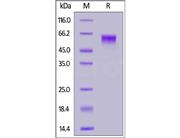
The protein has a calculated MW of 52.5 kDa. The protein migrates as 65-80 kDa under reducing (R) condition (SDS-PAGE) due to glycosylation.
Labeling
Biotinylation of this product is performed using Avitag™ technology. Briefly, the single lysine residue in the Avitag is enzymatically labeled with biotin.
Protein Ratio
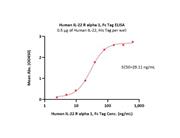
Passed as determined by the HABA assay / binding ELISA.
Purity
>95% as determined by SDS-PAGE.
>95% as determined by SEC-MALS.
Formulation
Lyophilized from 0.22 μm filtered solution in 50 mM Tris, 100 mM Glycine, 25 mM Arginine, 150 mM NaCl, pH7.5 with trehalose as protectant.
Contact us for customized product form or formulation.
Reconstitution
Please see Certificate of Analysis for specific instructions.
For best performance, we strongly recommend you to follow the reconstitution protocol provided in the CoA.
Storage
For long term storage, the product should be stored at lyophilized state at -20°C or lower.
Please avoid repeated freeze-thaw cycles.
This product is stable after storage at:
-20°C to -70°C for 12 months in lyophilized state;
-70°C for 3 months under sterile conditions after reconstitution.
Background
Interleukin-10 receptor subunit alpha (IL-10 R alpha ) is a cell surface receptor for the cytokine IL-10 that participates in IL-10 mediated anti-inflammatory functions, limiting excessive tissue disruption caused by inflammation. Upon binding to IL10, induces a conformational change in IL10RB, allowing IL10RB to bind IL10 as well.In turn, the heterotetrameric assembly complex, composed of two subunits of IL10RA and IL10RB, activates the kinases JAK1 and TYK2 that are constitutively associated with IL10RA and IL10RB respectively.These kinases then phosphorylate specific tyrosine residues in the intracellular domain in IL10RA leading to the recruitment and subsequent phosphorylation of STAT3.





 China
China