Human NT-3 Protein, Tag Free, low endotoxin (HPLC verified)
Synonym
HDNF, Nerve growth factor 2, NGF-2, Neurotrophic factor, NTF3, NT3.Neurotrophin3
Source
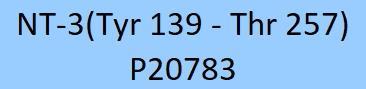
Human NT-3 Protein, Tag Free (NT3-H5213) is expressed from human 293 cells (HEK293). It contains AA Tyr 139 - Thr 257 (Accession # P20783).
Predicted N-terminus: Tyr 139
Molecular Characterization
This protein carries no "tag".
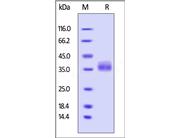
The protein has a calculated MW of 13.6 kDa. The protein migrates as 13-14 kDa when calibrated against Star Ribbon Pre-stained Protein Marker under reducing (R) condition (SDS-PAGE) due to glycosylation.
Endotoxin
Less than 0.01 EU per μg by the LAL method / rFC method.
Purity
>90% as determined by SDS-PAGE.
>95% as determined by SEC-HPLC.
Formulation
Lyophilized from 0.22 μm filtered solution in PBS, pH7.4 with trehalose as protectant.
Contact us for customized product form or formulation.
Reconstitution
Please see Certificate of Analysis for specific instructions.
For best performance, we strongly recommend you to follow the reconstitution protocol provided in the CoA.
Storage
For long term storage, the product should be stored at lyophilized state at -20°C or lower.
Please avoid repeated freeze-thaw cycles.
This product is stable after storage at:
-20°C to -70°C for 12 months in lyophilized state;
-70°C for 3 months under sterile conditions after reconstitution.
Background
Neurotrophin-3 (NT-3), encoded by the NTF3 gene, is a member of the NGF family of neurotrophic factors (also named neurotrophins). The neurotrophin family is comprised of at least four proteins including NGF, BDNF, NT-3, and NT-4/5. These secreted cytokines are synthesized as prepropeptides that are proteolytically processed to generate the mature proteins. Their functions including supporting the survival and differentiation of existing neurons, encouraging the growth and differentiation of new neurons and synapses, are required in both the central and the peripheral nervous systems. NT-4 signals predominantly through the TrkB receptor tyrosine kinase. NTF3-deficient mice generated by gene targeting display severe movement defects of the limbs. The mature peptide of this protein is identical in all mammals examined including human, pig, rat and mouse.




 China
China