Synonym
NY-ESO-1 TCR & CD3E & CD3D & CD3G & CD3Z
Source
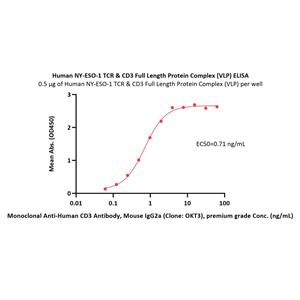
Human NY-ESO-1 TCR & CD3 Full Length Protein Complex (VLP) (NYZ-H5213) is expressed from human 293 cells (HEK293). It contains AA Asp 23 - Ile 207 & Phe 22 - Lys 171 & Gln 23 - Asn 182 & Gln 22 - Arg 164 (Accession # P07766-1 & P04234-1 & P09693-1 & P20963-1).
Predicted N-terminus: Met
Molecular Characterization
Virus-like particles(VLPs) are formed by self-assembly of capsid proteins from viruses. Membrane Proteins can be constituted in-situ with VLPs produced from HEK293 cell cultures. These VLPs concentrate conformationally intact membrane proteins directly on the cell surface and produce soluble, high-concentration proteins perfect for immunization and antibody screening.

The VLPs provide the display of properly folded membrane proteins in their native cellular membrane in a compact size of 100~300 nm diameter (similar to the size of most viruses) making it optimal targets for dendritic cells in vivo and surface attachment for phage display.
Endotoxin
Less than 1.0 EU per μg by the LAL method / rFC method.
Formulation
The VLPs are highly immunogenic, so the immunization strategy should be optimized (antigen dose, regimen and adjuvant).
Supplied as 0.2 μm filtered solution in PBS, Arginine, pH7.4 with trehalose as protectant.
Contact us for customized product form or formulation.
Shipping
This product is supplied and shipped with dry ice, please inquire the shipping cost.
Storage
Please avoid repeated freeze-thaw cycles.
This product is stable after storage at:
The product MUST be stored at -70°C or lower upon receipt;
-70°C for 12 months under sterile conditions.
Background
Cluster of Differentiation 3 (CD3) is a pivotal multimeric T cell co-receptor complex essential for adaptive immune responses. Composed of epsilon (ε), gamma (γ), delta (δ), and zeta (ζ) polypeptide chains forming three distinct dimers (εγ, εδ, ζζ), CD3 non-covalently associates with the T-cell receptor (TCR) to establish the critical TCR/CD3 receptor complex on T cell surfaces. Structurally, CD3 proteins belong to the immunoglobulin superfamily, featuring a transmembrane domain, an N-terminal extracellular region with immunoglobulin-like domains, and cytoplasmic tails embedded with immunoreceptor tyrosine-based activation motifs (ITAMs). These ITAMs are fundamental for initiating signal transduction upon T cell receptor engagement, thereby activating both CD4+ T helper and CD8+ cytotoxic T cells. As a defining marker of the T cell lineage, CD3's central role in T cell activation makes its modulation, via stimulating or blocking antibodies, a promising therapeutic avenue for conditions like organ transplant rejection and autoimmune diseases.


 China
China