Synonym
PDGFRB, CD140B, JTK12, PDGF-R-beta, PDGFR-2, PDGFR-beta, PDGFR-β
Source
Human PDGF R beta, Fc Tag (PDB-H5259) is expressed from human 293 cells (HEK293). It contains AA Leu 33 - Phe 530 (Accession # P09619-1).
Predicted N-terminus: Leu 33
Request for sequence
Molecular Characterization

Other Tags and Version Biotin & Other Labeled Version
This protein carries a human IgG1 Fc tag at the C-terminus.
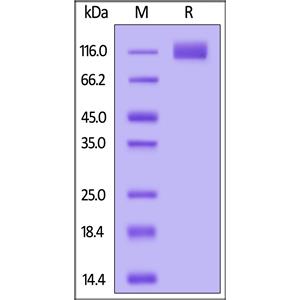
The protein has a calculated MW of 83.1 kDa. The protein migrates as 100-120 kDa under reducing (R) condition (SDS-PAGE) due to glycosylation.
Endotoxin
Less than 1.0 EU per μg by the LAL method / rFC method.
Purity
>95% as determined by SDS-PAGE.
Formulation
Lyophilized from 0.22 μm filtered solution in PBS, pH7.4 with trehalose as protectant.
Contact us for customized product form or formulation.
Reconstitution
Please see Certificate of Analysis for specific instructions.
For best performance, we strongly recommend you to follow the reconstitution protocol provided in the CoA.
Storage
For long term storage, the product should be stored at lyophilized state at -20°C or lower.
Please avoid repeated freeze-thaw cycles.
This product is stable after storage at:
-20°C to -70°C for 12 months in lyophilized state;
-70°C for 3 months under sterile conditions after reconstitution.
Background
Human platelet-derived growth factor receptor, beta polypeptide (PDGFRB) is also called J03278, M21616, CD140B, JTK12, PDGF-R-beta and PDGFR, is receptor that binds specifically to PDGFB and has a tyrosine-protein kinase activity. Is a cell surface tyrosine kinase receptor for members of the platelet-derived growth factor (PDGF) family. The PDGFR/PDGF system includes two receptors (PDGFRA and PDGFRB) and four ligands (A, B, C and D). The receptors PDGFRA and PDGFRB are related in sequence and both are members of the class III subtype of receptor tyrosine kinases (RTKs). Other class III RTKs are CSF1R, KIT and FLT3. PDGF binding induces receptor homo- and heterodimerization and signal transduction. The expression of the α and β receptors is independently regulated in various cell types. Recombinant soluble PDGFRB binds PDGF with high affinity and is potent PDGF antagonist. The ligands form either homo- or heterodimers (PDGF-AA, -AB, -BB, -CC, -DD). The four PDGFs are inactive in their monomeric forms. The PDGFs bind to the protein tyrosine kinase receptors PDGF receptor-α and -β. These two receptor isoforms dimerize upon binding the PDGF dimer, leading to three possible receptor combinations, namely -αα, -ββ and -αβ. PDGF-CC specifically interacts with PDGFR-αα and -αβ, but not with –ββ, and thereby resembles PDGF-AB. PDGF-DD binds to PDGFR-ββ with high affinity, and to PDGFR-αβ to a much lower extent and is regarded as PDGFR-ββ specific. PDGF-AA binds only to PDGFR-αα, while PDGF-BB is the only PDGF that can bind all three receptor combinations with high affinity.



 China
China