Human IL-11 Protein, His Tag
Synonym
IL-11, Interleukin-11, AGIF, Oprelvekin, IL11
Source
Human IL-11 Protein, His Tag (IL1-H5243) is expressed from human 293 cells (HEK293). It contains AA Pro 22 - Leu 199 (Accession # P20809-1).
Predicted N-terminus: His
Molecular Characterization

This protein carries a polyhistidine tag at the N-terminus.
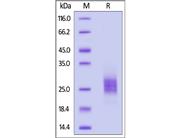
The protein has a calculated MW of 21.0 kDa. The protein migrates as 23-29 kDa when calibrated against Star Ribbon Pre-stained Protein Marker under reducing (R) condition (SDS-PAGE) due to glycosylation.
Endotoxin
Less than 0.1 EU per μg by the LAL method / rFC method.
Sterility
Negative
Purity
>90% as determined by SDS-PAGE.
Formulation
Lyophilized from 0.22 μm filtered solution in Citrate buffer, pH3.0 with trehalose as protectant.
Contact us for customized product form or formulation.
Reconstitution
Please see Certificate of Analysis for specific instructions.
For best performance, we strongly recommend you to follow the reconstitution protocol provided in the CoA.
Storage
For long term storage, the product should be stored at lyophilized state at -20°C or lower.
Please avoid repeated freeze-thaw cycles.
This product is stable after storage at:
-20°C to -70°C for 12 months in lyophilized state;
-70°C for 3 months under sterile conditions after reconstitution.
Background
Interleukin-11 (IL-11) is a pleiotropic cytokine that stimulates megakaryocytopoiesis, resulting in increased production of platelets, as well as activating osteoclasts, inhibiting epithelial cell proliferation and apoptosis, and inhibiting macrophage mediator production. These functions may be particularly important in mediating the hematopoietic, osseous and mucosal protective effects of IL-11. The cytokine also possesses anti-inflammatory activity, and has been proposed as a therapeutic agent in the treatment of chronic inflammatory diseases, such as Crohn's disease and rheumatoid arthritis. Although IL-11 was initially believed to be restricted to mammals, subsequent studies demonstrated it to be expressed in fish. Despite close similarity in gene structure and conservation of key amino acids between fish and mammalian IL-11, they share relatively low overall amino acid identity and may not necessarily be functionally analogous.




 China
China