Human IL-13 R alpha 2 Protein, His Tag (MALS verified)
Synonym
IL13RA2, CD213A2, CT19, IL-13R, IL13BP
Source
Human IL-13 R alpha 2, His Tag (IL2-H52H5) is expressed from human 293 cells (HEK293). It contains AA Asp 27 - Arg 343 (Accession # Q14627-1).
Predicted N-terminus: Asp 27
Molecular Characterization

This protein carries a polyhistidine tag at the C-terminus.
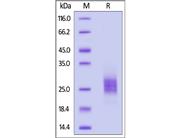
The protein has a calculated MW of 39.0 kDa. The protein migrates as 45-55 kDa under reducing (R) condition (SDS-PAGE) due to glycosylation.
Endotoxin
Less than 1.0 EU per μg by the LAL method / rFC method.
Purity
>90% as determined by SDS-PAGE.
>95% as determined by SEC-MALS.
Formulation
Lyophilized from 0.22 μm filtered solution in PBS, pH7.4 with trehalose as protectant.
Contact us for customized product form or formulation.
Reconstitution
Please see Certificate of Analysis for specific instructions.
For best performance, we strongly recommend you to follow the reconstitution protocol provided in the CoA.
Storage
For long term storage, the product should be stored at lyophilized state at -20°C or lower.
Please avoid repeated freeze-thaw cycles.
This product is stable after storage at:
-20°C to -70°C for 12 months in lyophilized state;
-70°C for 3 months under sterile conditions after reconstitution.
Background
Interleukin-13 receptor subunit alpha-2 is also known as IL13Rα2, IL13Ra2 cluster of differentiation 213A2, CD213A2, CT19, IL-13R, IL13BP, and is a membrane bound protein that in humans is encoded by the IL13RA2 gene. IL13Rα2 is closely related to IL13Rα1, a subunit of the interleukin-13 receptor complex. This protein binds IL13 with high affinity, but lacks any significant cytoplasmic domain, and does not appear to function as a signal mediator. It is, however able to regulate the effects of both IL13 and IL4, despite the fact it is unable to bind directly to the latter. It is also reported to play a role in the internalization of IL13. IL13Rα2 is a component of the cell surface receptors, however, the majority exists in intracellular pools and in soluble form, and thus plays an opposite role as a potent IL13 antagonist compared with IL13Rα1. It also functions as an inhibitor of IL4-dependent pathway probably through the physical interaction between the short intracellular domain of and cytoplasmic domain of IL13Rα2 and the IL4Rα chain. In spite of the failed STAT signaling function, IL13Rα2 dose induce TGF-beta production and fibrosis. Additionally, IL13Rα2has been reported to be abundantly and specifically overexpressed in glioblastoma multiforme.





 China
China