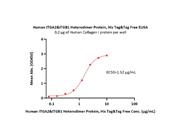
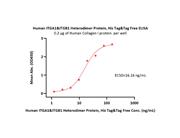
Human Integrin alpha V beta 5 (ITGAV&ITGB5) Heterodimer Protein, His Tag&Tag Free
Synonym
Integrin alpha V beta 5, ITGAV&ITGB5
Source
Human ITGAV&ITGB5 Heterodimer Protein, His Tag&Tag Free (IT5-H52W5) is expressed from human 293 cells (HEK293). It contains AA Phe 31 - Val 992 (ITGAV) & Gly 24 - Asn 719 (ITGB5) (Accession # NP_002201.1 (ITGAV) & NP_002204.2 (ITGB5)).
Predicted N-terminus: Phe 31 (ITGAV) & Gly 24 (ITGB5)
Molecular Characterization
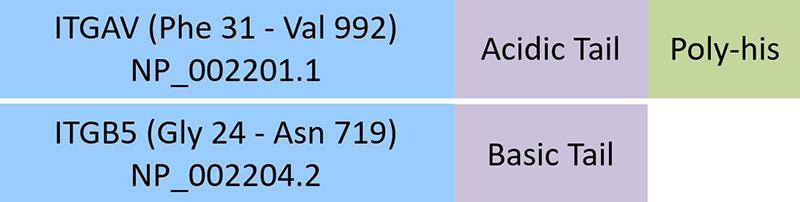
Human ITGAV&ITGB5 Heterodimer Protein, His Tag&Tag Free, produced by co-expression of ITGAV and ITGB5, has a calculated MW of 112.9 kDa (ITGAV) and 81.9 kDa (ITGB5). Subunit ITGAV is fused with polyhistidine tag at the C-terminus and followed by a acidic tail and subunit ITGB5 contains no tag but a basic tail at the C-terminus. The non-reducing (NR) protein migrates as 140-160 kDa (ITGAV) and 80-95 kDa (ITGB5) respectively due to glycosylation.
Endotoxin
Less than 1.0 EU per μg by the LAL method / rFC method.
Purity
>95% as determined by SDS-PAGE.
Formulation
Lyophilized from 0.22 μm filtered solution in 50 mM Tris, 150 mM NaCl, pH7.5 with trehalose as protectant.
Contact us for customized product form or formulation.
Reconstitution
Please see Certificate of Analysis for specific instructions.
For best performance, we strongly recommend you to follow the reconstitution protocol provided in the CoA.
Storage
For long term storage, the product should be stored at lyophilized state at -20°C or lower.
Please avoid repeated freeze-thaw cycles.
This product is stable after storage at:
-20°C to -70°C for 12 months in lyophilized state;
-70°C for 3 months under sterile conditions after reconstitution.
Background
Integrin alpha V beta 5 (ITGAV & ITGB5) is expressed on a wide variety of cell types including keratinocytes, fibroblasts, adhesive monocytes, embryonic stem cells, and select endothelium and epithelium. ITGAV & ITGB5 binds ligands containing an RGD motif, notably vitronectin. Growth factors that increase PKC activity, such as VEGF or TGF alpha, promote ITGAV & ITGB5-mediated angiogenesis while alpha V beta 3, which may be expressed in the same cell, responds to FGF-basic and TNF alpha. An inhibitor of both down regulates tumor angiogenesis. During lung inflammation, up regulation of ITGAV & ITGB5 on myofibroblasts or infiltrating lymphocytes may contribute to fibrosis by freeing TGF beta from latency.




 China
China