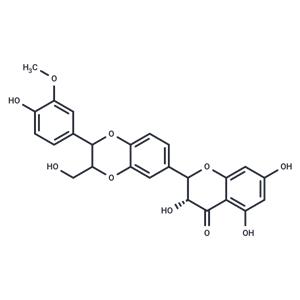
| Name | Isosilybin |
| Description | Isosilybin (Isosilibinin) and Silybin might be suitable candidates to design potent PXR antagonists to prevent drug-drug interactions via CYP3A4 in cancer patients. |
| Cell Research | LNCaP cells and 22Rv1 cells are plated and treated at 40–50% confluency with different doses of isosilybin B and isosilybin A (10–90 μM in medium) dissolved originally in Dimethyl sulfoxide (DMSO) for the desired time periods (24–48 h) in serum condition. An equal amount of DMSO (vehicle) is present in each treatment, including control; DMSO concentration did not exceed 0.1% (v/v) in any treatment. At the end of desired treatments, total cell number is determined by counting each sample in duplicate using a hemocytometer under an inverted microscope. Cell viability is determined using trypan blue exclusion method[2]. |
| In vitro | The reporter gene assay demonstrates that the milk thistle constituents silybin and isosilybin inhibit the PXR-mediated induction of CYP3A4, with isosilybin being a more potent inhibitor. Concentrations of 89, 133, and 200 μM of isosilybin decrease CYP3A4 induction by 64, 82, and 88%, respectively, and achieve an IC50 of 74 μM[1]. Additionally, the diastereoisomers isosilybin B and isosilybin A, derived from silymarin, exhibit anti-prostate cancer (PCA) activity through cell cycle arrest and apoptosis induction in human prostate cancer cells LNCaP and 22Rv1[2]. Isosilybin B enhances phosphorylation of Akt and Mdm2, leading to androgen receptor degradation, which is reversed by PI3K inhibitor pretreatment. This process facilitates the formation of a complex that promotes phosphorylation-dependent ubiquitination and subsequent degradation of the androgen receptor[3]. Isosilybin A significantly activates PPARγ at a 30 μM concentration, leading to a concentration-dependent transactivation of a PPARγ-dependent luciferase reporter. In silico docking studies indicate isosilybin A interacts with the receptor's ligand-binding domain through an additional hydrogen bond not found with inactive silymarin constituents[4]. |
| Storage | Keep away from direct sunlight | Shipping with blue ice/Shipping at ambient temperature. |
| Solubility Information | DMSO : 125 mg/mL (259.1 mM), Sonication is recommended.
Chloroform, Dichloromethane, Ethyl Acetate : Soluble
10% DMSO+40% PEG300+5% Tween 80+45% Saline : 3.3 mg/mL (6.84 mM), Sonication is recommended.
|
| Keywords | Q100795 | Q 100795 | Isosilybin | Cytochrome P450 | CYP3A4 |
| Inhibitors Related | Tebuconazole | Oxadiazon | Musk ketone | Naringin dihydrochalcone | Ipriflavone | Benzyl alcohol | Sudan IV | Naringin | Chlorzoxazone | Dibenzothiophene | Clarithromycin | Memantine hydrochloride |
| Related Compound Libraries | Anti-Tumor Natural Product Library | Polyphenolic Natural Product Library | Flavonoid Natural Product Library | Traditional Chinese Medicine Monomer Library | Bioactive Compound Library | Selected Plant-Sourced Compound Library | Inhibitor Library | Natural Product Library for HTS | Anti-Aging Compound Library | Bioactive Compounds Library Max | Heat-Clearing and Detoxifying Traditional Chinese Medicine Compound Library | Food as Medicine Compound Library |

 United States