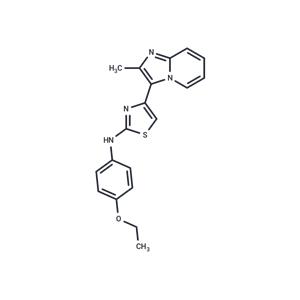
| Name | JK184 |
| Description | JK184, a potent Hedgehog (Hh) pathway inhibitor. |
| Cell Research | JK184 is dissolved in DMSO and stored, and then diluted with appropriate medium before use[1]. The Shh-LIGHT2 cells are seeded in 96-well plates and grown to confluency. The Shh-LIGHT2 cells are treated with various concentrations of JK184 micelles or free JK184 or micelles in DMEM containing 0.5% CS, 0.1 mg/mL streptomycin, 100 U/mL penicillin, 5% Shh-N conditioned medium obtained from Shh-N-producing HEK293 cells. The treated cells are cultured further for 60 h, and firefly and Renilla luciferase activities are measured using a dual luciferase kit. Proliferation assay or apoptosis evaluation of HUVECs is measured using MTT method or FCM analysis, respectively. HUVECs are treated with a series concentration of free JK184, JK184 micelles, or blank MPEG-PCL micelles for 48 h, respectively. The mean percentage of cell inhibition or apoptosis is calculated[1]. |
| In vitro | JK184 is specifically designed to counteract Hedgehog (Hh) signaling through the inhibition of glioma-associated oncogene (Gli)-dependent transcriptional activity in a dose-dependent fashion. It effectively reduces the growth of human umbilical vein endothelial cells (HUVECs) with a half maximal inhibitory concentration (IC50) of 6.3 μg/mL following a three-day incubation period. Moreover, MTT assays reveal that JK184 significantly restricts tumor growth in Panc-1 and BxPC-3 cell lines, demonstrating IC50 values of 23.7 ng/mL and 34.3 ng/mL, respectively. Notably, cell lines characterized by lower levels of the tight junction protein claudin show increased sensitivity to JK184, with the compound inducing a dose-dependent reduction in both GLI1 mRNA and protein expressions. Additionally, administering JK184 at the IC50 concentration significantly increases Annexin-V staining in HMLE-shEcad cells while maintaining negativity for propidium iodide (PI) staining, indicating a pronounced pro-apoptotic effect without compromising cell membrane integrity (P<0.0001, t-test)[1][2]. |
| In vivo | JK184 (5 mg/kg, injected intravenously) demonstrates strong anti-proliferative activity in subcutaneous Panc-1 and BxPC-3 tumor models, making it a promising candidate as an antitumor drug targeting Hh signaling. Histological analysis revealed that JK184 enhances anti-tumor activity by inducing apoptosis, decreasing microvessel density, and reducing CD31, Ki67, and VEGF expression in tumor tissues. However, JK184 exhibits a poor pharmacokinetic profile and bioavailability[1]. |
| Storage | Shipping with blue ice/Shipping at ambient temperature. |
| Solubility Information | 10% DMSO+40% PEG300+5% Tween 80+45% Saline : 1 mg/mL (2.85 mM), Sonication is recommended.
DMSO : 3.51 mg/mL (10.02 mM), Sonication is recommended.
|
| Keywords | Smoothened | JK-184 | JK184 | JK 184 | Inhibitor | inhibit | Hedgehog |
| Inhibitors Related | Itraconazole | Naftifine hydrochloride | GANT 61 | ALLO-2 | 5-LOX inhibitor | Ellagic acid | Triparanol | Purmorphamine | Vismodegib | BMS-833923 | RU-SKI 43 | Sonidegib |
| Related Compound Libraries | Osteogenesis Compound Library | Reprogramming Compound Library | Target-Focused Phenotypic Screening Library | Bioactive Compound Library | Cancer Cell Differentiation Compound Library | Membrane Protein-targeted Compound Library | Inhibitor Library | NO PAINS Compound Library | Anti-Prostate Cancer Compound Library | Stem Cell Differentiation Compound Library | Bioactive Compounds Library Max | GPCR Compound Library |


 United States