Human Klotho beta / KLB Protein, His Tag
Synonym
betaKlotho, beta-klotho, BKL, KLB, klotho beta like, klotho beta-like protein
Source
Human Klotho beta Protein, His Tag (KLB-H52H4) is expressed from human 293 cells (HEK293). It contains AA Met 30 - Leu 997 (Accession # Q86Z14-1).
Predicted N-terminus: Met 30
Molecular Characterization

This protein carries a polyhistidine tag at the C-terminus.
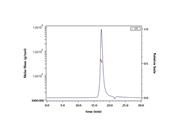
The protein has a calculated MW of 112.9 kDa. The protein migrates as 120-130 kDa when calibrated against Star Ribbon Pre-stained Protein Marker under reducing (R) condition (SDS-PAGE) due to glycosylation.
Endotoxin
Less than 1.0 EU per μg by the LAL method / rFC method.
Purity
>90% as determined by SDS-PAGE.
Formulation
Lyophilized from 0.22 μm filtered solution in PBS, pH7.4 with trehalose as protectant.
Contact us for customized product form or formulation.
Reconstitution
Please see Certificate of Analysis for specific instructions.
For best performance, we strongly recommend you to follow the reconstitution protocol provided in the CoA.
Storage
For long term storage, the product should be stored at lyophilized state at -20°C or lower.
Please avoid repeated freeze-thaw cycles.
This product is stable after storage at:
-20°C to -70°C for 12 months in lyophilized state;
-70°C for 3 months under sterile conditions after reconstitution.
Background
KLB (Klotho Beta) is a Protein Coding gene. Among its related pathways are RET signaling and HIV Life Cycle. GO annotations related to this gene include hydrolase activity, hydrolyzing O-glycosyl compounds and fibroblast growth factor binding. An important paralog of this gene is KL. Klotho Beta is a regulator in multiple metabolic processes, while its role in cancer remains unclear. We found the expression of βKlotho was down-regulated in human hepatocellular carcinoma tissues compared with that in paired adjacent non-tumourous liver tissues. Hepatoma cells also showed decreased expression of βKlotho compared with normal hepatocyte cells. Reintroduction of βKlotho into hepatoma cells inhibited their proliferation.




 China
China