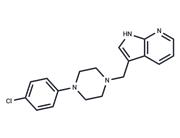
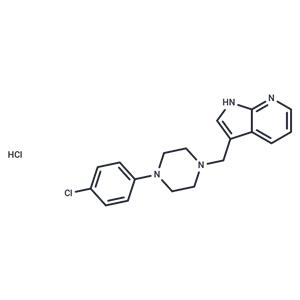
| Name | L-745870 hydrochloride |
| Description | L-745870 hydrochloride has excellent brain penetration. L-745870 hydrochloride is a high-affinity, selective and orally active human dopamine D4 receptor antagonist with a Ki of 0.43 nM, and considerably weaker D2 receptor affinity with a Ki of 960 nM and D3 receptor affinity with a Ki of 2300 nM. |
| In vitro | In vitro pharmacological studies revealed that L-745870 is an antagonist at human D4 receptors, in that L-745870 antagonized the ability of D4 receptors to inhibit agonist-induced stimulation of [35S]-GTPgS binding,?blocked the inhibition of forskolin-stimulated adenylate cyclase activity in transfected human embryonic kidney (HEK293) and Chinese hamster ovary (CHO) cells,?blocked dopamine-induced inhibition of Ca2+ currents in transfected GH4C1 pituitary cells,?inhibited D4 activation of cloned G protein-coupled inwardly rectifying K+ channels,?and antagonized dopamine-induced stimulation of extracellular acidification in transfected cells[1]. |
| In vivo | L-745870 exhibits favorable pharmacokinetic properties (20-60% oral bioavailability and plasma t1/2 of 2.1-2.8 hours) in both rats and monkeys, with excellent brain penetration and high brain-to-plasma ratios in rats[1]. Evaluation of L-745870 in surrogate marker assays indicates that it is readily available for biological activity in the brain and at doses of 5 to 60 mg/kg p.o., it would occupy 50% of D4 receptors in the brain. L-745870 does not affect apomorphine-induced stereotypy in rats but induces catalepsy in mice at a high dose of 100 mg/kg p.o., likely due to D2 receptor occupancy. Higher doses of L-745870 are anticipated to cause extrapyramidal symptoms in primates as these CNS levels would antagonize D2 receptors. In squirrel monkeys, L-745870 (10 mg/kg p.o.) induces mild sedation and at 30 mg/kg, it causes noticeable extrapyramidal motor symptoms, notably bradykinesia[1]. |
| Storage | Shipping with blue ice/Shipping at ambient temperature. |
| Solubility Information | DMSO : 55 mg/mL (151.4 mM), Sonication is recommended.
0.1 M HCl : 20 mg/mL (55.05 mM)
|
| Keywords | receptor | penetration | neuroleptics | L-745870 Hydrochloride | L745870 Hydrochloride | L-745870 | L745870 | L 745870 Hydrochloride | L 745870 | Inhibitor | inhibit | Human dopamine D4 receptor | Human dopamine D3 receptor | Human dopamine D2 receptor | human D4 receptor | human D3 receptor | human D2 receptor | Human | DopamineReceptor | Dopamine Receptor | dopamine | brain |
| Inhibitors Related | Trifluoperazine dihydrochloride | Clozapine N-Oxide | Mirtazapine | Hexamethonium Bromide | Butyrophenone | Octopamine hydrochloride | L-DOPA | Creatine | Dopamine hydrochloride | Oxolinic acid | Mianserin hydrochloride | Doxepin hydrochloride |
| Related Compound Libraries | Anti-Neurodegenerative Disease Compound Library | Bioactive Compound Library | Anti-Alzheimer's Disease Compound Library | Neuronal Signaling Compound Library | Membrane Protein-targeted Compound Library | Anti-Parkinson's Disease Compound Library | CNS-Penetrant Compound Library | Inhibitor Library | Orally Active Compound Library | Bioactive Compounds Library Max | GPCR Compound Library | Anti-Cancer Compound Library |


 United States