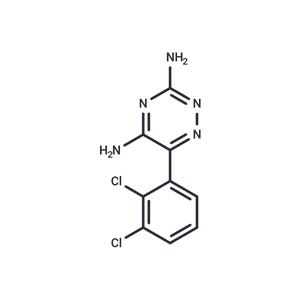
| Name | Lamotrigine |
| Description | Lamotrigine (BW430C) is an Anti-epileptic Agent and Mood Stabilizer. The physiologic effect of lamotrigine is by means of Decreased Central Nervous System Disorganized Electrical Activity. |
| Kinase Assay | Whole Cell [3H]R1881 Binding Assay: Fibroblasts are grown to confluence in five or six 150 cm2 tissue culture flasks for routine assay. This usually requires 4-6 weeks from the time of the initial seeding of the cell line. All studies are performed between passages 3-20. Two days before assay, the medium is changed to one lacking fetal calf serum. This is repeated again 24 hours before assay. Competition assays are performed with 0.5-1.0 nM [3H]R1881 and increasing amounts of the nonradioactive compounds. Binding to low affinity sites is determined in the presence of 5 × 10⁻⁷ M R1881 and is subtracted from whole cell binding of [3H]R 1881 obtained in the absence of any inhibitor to assess binding to 5 high affinity site |
| In vitro | Lamotrigine is active in electrically induced EEG after-discharge tests, indicating its ability to counteract simple and complex partial seizures. It demonstrates antiepileptic effects in mice and rats, preventing hind-limb extension induced by both MES (maximal electroshock) and pentylenetetrazole. The peak effects of Lamotrigine occur 1 hour post-administration, with a duration exceeding 24 hours. Intravenous administration of Lamotrigine at doses greater than 5 mg/kg in rats results in a dose-dependent reduction in after-discharge duration. |
| In vivo | In rat cortical brain tissues cultured with 10 mg/L veratridine, Lamotrigine inhibited the release of glutamate and aspartate (both with an ED50 of 5.38 mg/L) twice as effectively as it inhibited the release of GABA (ED50 of 11.2 mg/L), without affecting the basal release of glutamate. Lamotrigine stabilizes presynaptic neuronal membranes by blocking voltage-dependent sodium channels, thereby preventing the release of excitatory neurotransmitters, especially glutamate and aspartate. It does not induce phencyclidine (PCP)-like central nervous system effects, does not act through direct inhibition of NMDA receptors, and may avoid the adverse effects associated with NMDA blockade. |
| Storage | Powder: -20°C for 3 years | In solvent: -80°C for 1 year | Shipping with blue ice. |
| Solubility Information | DMSO : 18.33 mg/mL (71.58 mM), Sonication is recommended.
Ethanol : 2.6 mg/mL (10.15 mM), Sonication is recommended.
|
| Keywords | tonic-clonic seizure | SodiumChannel | Sodium Channel | seizure | Na+ channels | Na channels | Lennox-Gastaut syndrome | Lamotrigine | Inhibitor | inhibit | focal seizure | epilepsy | Autophagy | 5HTReceptor | 5HT Receptor | 5-HT (rat brain synaptosomes) | 5-HT (human platelets) |
| Inhibitors Related | Stavudine | Aceglutamide | Phenytoin sodium | Sodium 4-phenylbutyrate | Hydroxychloroquine | Guanidine hydrochloride | Taurine | Valproic Acid | Curcumin | Paeonol | Naringin | Gefitinib |
| Related Compound Libraries | Bioactive Compound Library | Membrane Protein-targeted Compound Library | Anti-Cancer Clinical Compound Library | Drug Repurposing Compound Library | Neuroprotective Compound Library | Inhibitor Library | FDA-Approved Drug Library | Anti-Aging Compound Library | Bioactive Compounds Library Max | Ion Channel Targeted Library | GPCR Compound Library | Anti-Cancer Drug Library |


 United States