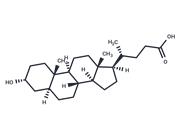
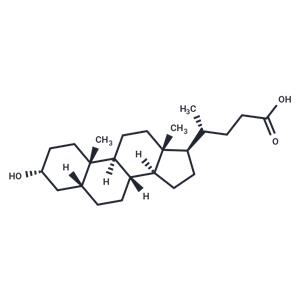
| Name | Lithocholic acid |
| Description | Lithocholic acid (3α-Hydroxy-5β-cholanic acid) is a toxic secondary bile acid, They were FXR antagonists (IC50=0.7, 1.4 μM), EphA2 antagonists (IC50=48, 66 μM) and EphB4 antagonists (IC50=141 μM). Lithocholic acid can promote intrahepatic cholestasis and promote tumorigenesis. Lithocholic acid is a cleanser that dissolves fat for absorption and is itself absorbed. |
| Kinase Assay | Competitive ligand binding assay.: Ligand binding is performed using lysates from COS-7 cells transfected with expression plasmids for VDR or RXRα. Binding is performed overnight at 4°C in lysate buffer with 0.71 nM (18 Ci/mmol) [3H]1,25(OH)2D3 and bile acid competitor. Unbound [3H]1,25(OH)2D3 is removed by adsorption to dextran-coated charcoal and the supernatant removed for scintillation counting. Ki values are calculated from a computer fit of competition curves from triplicate assays. |
| In vitro | METHODS: Human A549, HCT-116, HT-29, Huh-7, LoVo, MGC-803, RKO, SK-HEP1, SW480 cells were treated with Lithocholic acid (200, 100, 50, P < 0.05). 25, 12.5, 6.25, 3.125, 1.5625 μM) were used to detect the cell growth inhibition by MTT method.
RESULTS: Lithocholic acid did not affect the growth of A549, HCT-116, HT-29, Huh-7, LoVo, MGC-803, RKO, SK-HEP1, and SW480 cells (IC50> 200 µM). [1]
METHODS: Human Caco2 and HT-1080 cells were treated with Lithocholic acid (0.1-1000 μM) for 24 hours, and the cytotoxicity was detected by MTT assay.
RESULTS: Lithocholic acid significantly inhibited the growth of Caco2 (IC50=56 μM) and HT-1080 cells (IC50=23 μM). [2]
METHODS: Human DLD1, HCT-116, and HCT-8 cells were treated with Lithocholic acid (25, 50, 100, 150, and 200μM) for 48 hours, and the cytotoxicity was detected by MTT assay.
RESULTS: Lithocholic acid significantly inhibited the growth of human DLD1 (IC50=173.1 μM), HCT-116 (IC50=81.1 μM) and HCT-8 (IC50=97.4 μM) cells. [3] |
| In vivo | METHODS: To investigate the antiviral effect of Lithocholic acid, Lithocholic acid oleate (3%) and Lithocholic acid (0.5%), derivatives of LCA, were administered to HSV-1 virus infected mice.
RESULTS: Mice treated with Lithocholic acid oleate+Lithocholic acid 48 hours before virus inoculation showed lesions on day 6 after infection, and the wound healing was better than that of the acyclovir treatment group, with reduced scar formation and better skin repair. [4] |
| Storage | Shipping with blue ice/Shipping at ambient temperature. |
| Solubility Information | Ethanol : 44 mg/mL (116.84 mM), Sonication is recommended.
DMSO : 49 mg/mL (130.12 mM), Sonication is recommended.
H2O : < 1 mg/mL (insoluble or slightly soluble)
|
| Keywords | VD | PXR | Lithocholic acid | Inhibitor | inhibit | FXR | EndogenousMetabolite | Endogenous Metabolite | Autophagy | Apoptosis | 3alpha-Hydroxy-5beta-cholanic acid | 3a-Hydroxy-5b-cholanic acid |
| Inhibitors Related | Sucrose | Aceglutamide | Hemin | Nicotinamide riboside malate | DL-Lysine | D(+)-Raffinose pentahydrate | Guanidine hydrochloride | Malic acid | Glycerol | Thymidine | Corn starch | Gluconate Calcium |
| Related Compound Libraries | Anti-Tumor Natural Product Library | Bioactive Compound Library | Drug Repurposing Compound Library | Natural Product Library | Microbial Natural Product Library | FDA-Approved Drug Library | Anti-Cancer Approved Drug Library | Natural Product Library for HTS | Anti-Aging Compound Library | Human Endogenous Metabolite Library | Gut Microbial Metabolite Library | Anti-Cancer Drug Library |


 United States