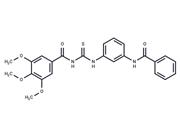
| Name | LM22B-10 |
| Description | LM22B-10, an activator of the TrkB/TrkC neurotrophin receptor, can induce activation of TrkB, TrkC, ERK, and AKT both in vitro and in vivo. |
| Cell Research | Mouse NIH-3T3 cells, mouse NIH-3T3 cells expressing TrkA (NIH-3T3-TrkA) or p75NTR (NIH-3T3-p75NTR), and NIH-3T3 cells expressing TrkB (NIH-3T3-TrkB) or TrkC (NIH-3T3-TrkC) are propagated in DMEM supplemented with 10% FBS and 200-400 μg/mL Geneticin (for Trk-expressing cells) or 400 μg/mL hygromycin (for p75NTR-expressing cells). Cells are seeded into 24-well plates (30,000 cells/well) and cultured in medium consisting of 50% PBS and 50% DMEM without supplements. Following exposure to growth factors (0.7 nM) or 1000 nM LM22B-10 for 72-96 h, cells are suspended in 50 μL lysis buffer, transferred to opaque 96-well culture plates and survival is measured using the ViaLight Assay. |
| In vitro | LM22B-10 exhibits superior neurotrophic activity, surpassing the highest levels of neurotrophic survival activity achieved by BDNF (53 ± 7.2% above BDNF at 0.7 nM) and NT-3 (91 ± 8.6% above NT-3 at 0.7 nM), with an EC50 value between 200-300 nM. At a concentration of 1000 nM, LM22B-10 significantly increases neurite length, achieving an average increment up to -40 μM. Furthermore, LM22B-10 demonstrates dose-dependent binding to TrkB-Fc and TrkC-Fc across a concentration range of 250-2000 nM. It effectively inhibits the binding of BDNF to TrkB-expressing cells and NT-3 to TrkC-expressing cells, supporting cell survival and preferentially engaging TrkB and TrkC pathways. Notably, LM22B-10 promotes neurite outgrowth even in inhibitory conditions, a capability not displayed by BDNF or NT-3. It triggers distinct Trk and subsequent signaling activation patterns, as well as stimulating TrkB, TrkC, AKT, and ERK activation in cultured hippocampal neurons, establishing its unique and potent neurotrophic effects compared to those of BDNF and NT-3[1]. |
| In vivo | LM22B-10, at a dosage of 0.5 mg/kg, stimulates TrkB, TrkC, AKT, and ERK pathways in C57BL/6J mice. At a higher concentration of 50 mg/kg administered intraperitoneally (i.p.), it induces enhanced phosphorylation at TrkBY817 and TrkCY820. Furthermore, LM22B-10 triggers synaptic activation of TrkB and TrkC, elevating both pre- and post-synaptic protein levels and augmenting spine density in elderly mice [1]. |
| Storage | Powder: -20°C for 3 years | In solvent: -80°C for 1 year
Shipping with blue ice/Shipping at ambient temperature. |
| Solubility Information | 10% DMSO+40% PEG300+5% Tween 80+45% Saline : 2 mg/mL (4.12 mM), Sonication is recommended.
Ethanol : 4.5 mg/mL (9.28 mM), Sonication is recommended.
DMSO : 50 mg/mL (103.09 mM), Sonication is recommended.
|
| Keywords | Tropomyosin related kinase receptor | Trkreceptor | TrkC | TrkB | Trk Receptor | Protein kinase B | PKB | LM22B-10 | LM-22B-10 | LM22B 10 | Inhibitor | inhibit | Extracellular signal regulated kinases | ERK | Akt |
| Inhibitors Related | Aceglutamide | Musk ketone | Stearamide | Urea | Bisphenol A | Gum arabic | Hyaluronic acid | Lactose | Ethyl linoleate | Methyl eugenol | Gluconate Calcium | 2,3-Butanediol |
| Related Compound Libraries | PI3K-AKT-mTOR Compound Library | Glycolysis Compound Library | Bioactive Compound Library | Pain-Related Compound Library | Membrane Protein-targeted Compound Library | Tyrosine Kinase Inhibitor Library | Kinase Inhibitor Library | Neuroprotective Compound Library | Anti-Aging Compound Library | Immunology/Inflammation Compound Library | Bioactive Compounds Library Max | Anti-COVID-19 Compound Library |


 United States