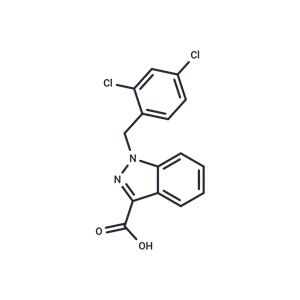
| Name | Lonidamine |
| Description | Lonidamine (Diclondazolic Acid) is an indazole carboxylic acid derivative, principally inhibiting aerobic glycolytic activity, by its effect on mitochondrially-bound hexokinase (HK). |
| In vitro | In mice carrying glioma tumors, Lonidamine (160 mg/kg) effectively reduced tumor growth. |
| In vivo | In both normal and tumor cells, Lonidamine reduces oxygen consumption while augmenting aerobic glycolysis in normal cells, thereby inhibiting aerobic glycolysis in tumor cells. The compound induces apoptosis at a concentration of 50 mg/ml in resistant cell lines, including the human breast cancer cell line MCF-7 ADR(r) and the LB9 multiform glioblastoma cell line, which exhibit resistance to doxorubicin and nitrosourea. |
| Storage | Powder: -20°C for 3 years | In solvent: -80°C for 1 year | Shipping with blue ice. |
| Solubility Information | DMSO : 60 mg/mL (186.82 mM), Sonication is recommended.
Ethanol : 1.6 mg/mL (4.98 mM), Sonication is recommended.
|
| Keywords | pulmonary fibrosis | MitochondrialMetabolism | Mitochondrial Metabolism | mitochondrial complex | Mitochondrial | lung fibrosis | Lonidamine | lactate | Inhibitor | inhibit | hexokinase | Hexokinase | H2030BrM3 | Apoptosis | AF-1890 | AF 1890 | A549 |
| Inhibitors Related | Stavudine | 5-Fluorouracil | Acetylcysteine | Imeglimin hydrochloride | Sodium 4-phenylbutyrate | L-Ascorbic acid | Dextran sulfate sodium salt (MW 4500-5500) | L-Glutamic acid | Metronidazole | Tributyrin | L-Ascorbic acid sodium salt | Salicylic acid |
| Related Compound Libraries | Failed Clinical Trials Compound Library | Bioactive Compound Library | Kinase Inhibitor Library | Anti-Cancer Clinical Compound Library | Drug Repurposing Compound Library | Inhibitor Library | FDA-Approved Kinase Inhibitor Library | Anti-Cancer Approved Drug Library | Anti-Aging Compound Library | Bioactive Compounds Library Max | Anti-Cancer Active Compound Library | Anti-Cancer Drug Library |


 United States