Human M-CSF / CSF-1 Protein, premium grade
Features and Advantages
1. Seamless Transition from Preclinical to Clinical: Same cell clone, process, and QC as GMP products.
2. Enhanced Production Standards: AOF raw materials, pharma-grade excipients, Grade B+A (ISO 5) environment.
3. Comprehensive Quality Control: Additional strict testing for process impurities, sterility, and mycoplasma.
4. Cost-Effective Solution: GMP-comparable quality at an economical price for early development.
5. Risk Mitigation: Enhanced safety through rigorous impurity control and comprehensive testing.
Synonym
M-CSF, CSF-1, Lanimostim
Source
Human M-CSF Protein, premium grade (MCF-H5218) is expressed from human 293 cells (HEK293). It contains AA Glu 33 - Arg 255 (Accession # P09603-1).
Predicted N-terminus: Glu 33
It is produced under our rigorous quality control system that incorporates a comprehensive set of tests including sterility and endotoxin tests. Product performance is carefully validated and tested for compatibility for cell culture use or any other applications in the early preclinical stage.
GMP-MCFH24 is the GMP version of this MCF-H5218. These two proteins display indistinguishable performance profiles, thereby ensuring a seamless transition for end users from early preclinical stage to later clinical phases.
Molecular Characterization
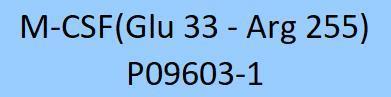
This protein carries no "tag".
The protein has a calculated MW of 25.1 kDa. The protein migrates as 39 kDa±3 kDa when calibrated against Star Ribbon Pre-stained Protein Marker under reducing (R) condition (SDS-PAGE) due to glycosylation.
Endotoxin
Less than 0.01 EU per μg by the LAL method / rFC method.
Host Cell Protein
<0.5 ng/µg of protein tested by ELISA.
Host Cell DNA
<0.02 ng/μg of protein tested by qPCR.
Sterility
Negative
Mycoplasma
Negative
Purity
>95% as determined by SDS-PAGE.
>90% as determined by SEC-MALS.
Formulation
Lyophilized from 0.22 μm filtered solution in PBS, pH7.4 with trehalose as protectant.
Contact us for customized product form or formulation.
Reconstitution
Please see Certificate of Analysis for specific instructions.
For best performance, we strongly recommend you to follow the reconstitution protocol provided in the CoA.
Storage
For long term storage, the product should be stored at lyophilized state at -20°C or lower.
Please avoid repeated freeze-thaw cycles.
This product is stable after storage at:
-20°C to -70°C for 24 months in lyophilized state;
-70°C for 3 months under sterile conditions after reconstitution.
Quality Description
ACRO's Research-grade products are suitable for a wide range of cell culture applications, particularly for research use in academic institutions. These products are sterilized by filtration before lyophilization. Typical specifications include endotoxin levels of <0.01 EU/μg and purities >95%. Biological activity is calibrated against WHO/NIBSC standards when available.
ACRO's Premium-grade (Pre-GMP) products are characterized by their high quality and enhanced safety profiles, making them ideal for early-stage discovery and manufacturing processes in cell therapy companies. A key advantage is their seamless transition to corresponding GMP-grade versions. Biological activity is calibrated against WHO/NIBSC standards when available. Typical specifications include endotoxin levels of <0.01 EU/μg and purities >95%. In addition, rigorous testing is conducted to ensure the absence of mycoplasma, HCD, and HCP, thereby guaranteeing product safety.
Background
The colony stimulating factor 1 (CSF1), also known as macrophage colony-stimulating factor (M-CSF), is a secreted cytokine which influences hematopoietic stem cells to differentiate into macrophages or other related cell types. Eukaryotic cells also produce M-CSF in order to combat intercellular viral infection. It is one of the three experimentally described colony-stimulating factors. M-CSF binds to the colony stimulating factor 1 receptor. Macrophage colony-stimulating factor has been shown to interact with PIK3R2. M-CSF (or CSF-1) is a hematopoietic growth factor that is involved in the proliferation, differentiation, and survival of monocytes, macrophages, and bone marrow progenitor cells. Locally produced M-CSF in the vessel wall contributes to the development and progression of atherosclerosis.





 China
China


