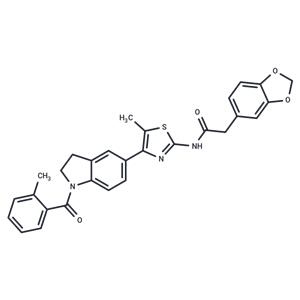
| Name | ML385 |
| Description | ML385 is an NRF2 inhibitor (IC50=1.9 μM) with novelty and specificity. ML385 has anti-inflammatory activity by modulating anti-oxidative stress through the inhibition of NRF2. ML385 also exhibits anti-tumor activity. |
| Cell Research | cells are treated with ML385 for 36 h. An equal amount of CellTiter-Blue reagent is added to the wells and the fluorescence is measured after 30 min. The CellTiter-Blue reagent is discarded and the Caspase-Glo (100 μL) reagent is added to the cells and incubated at 37°C for an additional 60-90 min. The resulting luminescence is recorded and the caspase activity is normalized to cell number |
| Animal Research | Mice tumor xenografts are administered intraperitoneally ML385 (30 mg/kg). |
| In vitro | METHODS: Human lung cancer cells A549 were treated with ML385 (0.25-5 μM) for 12-72 h. The expression levels of target genes were detected by RT-qPCR.
RESULTS: ML385 dose-dependently and time-dependently decreased the transcriptional activity of NRF2. [1]
METHODS: Human lung cancer cells EBC1 were treated with ML385 (1-25 μM) for 48 h, and the expression levels of target proteins were detected by Western Blot.
RESULTS: NRF2 expression was inhibited by treatment with 5 μM ML385. When the concentration of ML385 was increased above 5 μM, the NRF2 protein level was restored. [2] |
| In vivo | METHODS: To detect anti-tumor activity in vivo, ML385 (30 mg/kg) and carboplatin (5 mg/kg) were intraperitoneally injected into athymic nude mice harboring human lung cancer tumors A549 or H460 five times a week for three weeks.
RESULTS: Treatment with ML385 in combination with carboplatin showed a significant reduction in tumor growth. Although treatment with a single agent resulted in a reduction in tumor growth, the magnitude of these effects was variable between cell lines and did not reach statistical significance. [1]
METHODS: To investigate whether Nrf2 modulates acute liver failure (ACLF) through iron death, ML385 (30 mg/kg) was injected intraperitoneally four times per week for four weeks into BALB/c mice constructed in the ACLF model.
RESULTS: More severe histopathological lesions were observed in the ML385 group compared to the ACLF group. lipid peroxidation and liver injury were exacerbated by the Nrf2 inhibitor, ML385. [3] |
| Storage | Keep away from moisture | Shipping with blue ice/Shipping at ambient temperature. |
| Solubility Information | DMSO : 50 mg/mL (97.73 mM), Sonication is recommended.
10% DMSO+40% PEG300+5% Tween 80+45% Saline : 3 mg/mL (5.86 mM), Suspension.
50% PEG300+50% Saline : 5 mg/mL (9.77 mM), Suspension.
|
| Keywords | Nrf2 | ML-385 | ML385 | ML 385 | Keap1-Nrf2 | Inhibitor | inhibit | Ferroptosis |
| Inhibitors Related | Aceglutamide | Hemin | Acetylcysteine | Dimethyl fumarate | L-Glutamic acid | Sorafenib | Curcumin | L-Methionine | L-Cystine | L-Glutamine | (-)-Epigallocatechin Gallate | Sodium Molybdate |
| Related Compound Libraries | Anti-Neurodegenerative Disease Compound Library | Bioactive Compound Library | Anti-Obesity Compound Library | Antioxidant Compound Library | Inhibitor Library | PPI Inhibitor Library | Immunology/Inflammation Compound Library | Anti-Aging Compound Library | Bioactive Compounds Library Max | Anti-Cancer Compound Library | Anti-Cancer Active Compound Library | Oxidation-Reduction Compound Library |


 United States


