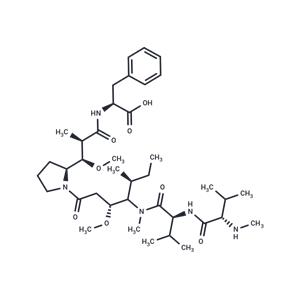
| Name | MMAF |
| Description | MMAF (MonoMethyl auristatin F), an antimitotic agent, inhibits cell division by blocking the polymerization of tubulin. |
| Cell Research | Cells are treated with serial dilutions of test molecules and incubated 4-6 days depending on cell line. Assessment of cellular growth and data reduction to generate IC50 values is done using Alamar Blue dye reduction assay[2]. |
| In vitro | MMAF shows in vitro cytotoxicity against a panel of cell lines. The IC50 values for Karpas 299, H3396, 786-O and Caki-1 are 119, 105, 257, and 200 nM, respectively. Targeted MMAF is much more potent than the free drug, and that cAC10 conjugates of MMAF display pronounced activities. On a molar basis, the cAC10-L1-MMAF4 is an average of over 2200-fold more potent than free MMAF and is active on all the CD30-positive cell lines tested[1]. |
| In vivo | The maximum tolerated dose in mice of MMAF (>16 mg/kg) is much higher than MMAE (1 mg/kg). cAC10-L1-MMAF4 has an MTD of 50 mg/kg in mice and 15 mg/kg in rats. The corresponding cAC10-L4-MMAF4 ADC was much less toxic, having MTDs in mice and rats of >150 mg/ kg and 90 mg/kg in rats, respectively[1]. |
| Storage | Keep away from moisture | Powder: -20°C for 3 years | Shipping with blue ice/Shipping at ambient temperature. |
| Solubility Information | DMSO : 250 mg/mL (341.55 mM), Sonication is recommended.
|
| Keywords | Monomethylauristatin F | MMAF | MicrotubuleAssociated | Microtubule/Tubulin | Microtubule Associated | Inhibitor | inhibit | Cytotoxicity( Karpas 299 cell) | ADCCytotoxin | ADC Payload | ADC Cytotoxin |
| Inhibitors Related | Methotrexate | Flubendazole | Doxorubicin hydrochloride | Methotrexate disodium | 4-Isopropoxybenzoic acid | Dexamethasone acetate | Pregnenolone acetate | α-Cyclodextrin | Dexamethasone | Methylene Blue trihydrate | 4'-Demethylepipodophyllotoxin | Exatecan Mesylate |


 United States