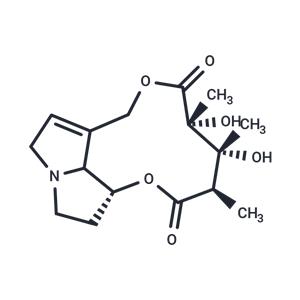
| Name | Monocrotaline |
| Description | Monocrotaline is an 11-membered macrocyclic pyrrolizidine alkaloid extracted from the seeds of Crotalaria plants. It inhibits organic cation transporters OCT-1 and OCT-2, with IC50 values of 36.8 µM and 1.8 mM, respectively. Monocrotaline exhibits antitumor activity and shows certain cytotoxicity against liver cancer cells such as HepG2. It is also commonly used to induce pulmonary arterial hypertension models in rodents. |
| In vitro | METHODS: Monocrotaline (Crotaline) (1, 5, 25, 75, 150 and 300 μM) was used to treat HepG2 clone9 cells and transcriptomic studies were conducted; Monocrotaline (75, 150, 300μM) was used to treat HepG2 clone9 cells and cell cycle analysis was conducted.
RESULTS The signaling pathways responsible for DNA damage repair and cell cycle regulation were only significant at the extremely toxic concentration of 300 μM; the S phase fraction of HepG2 clone9 cells increased, and the G2/M phase also increased significantly. [5] |
| In vivo | Induced pulmonary hypertension (PH) model:
Disease introduction: Pulmonary hypertension (PH) is a life-threatening disease characterized by endothelial damage, vascular smooth muscle cell proliferation and hypercontraction leading to increased pulmonary artery pressure. If left untreated, the disease will eventually lead to right ventricular (RV) failure and death.
Disease modeling: I. Induced chronic progressive PH
1. Animal model: rats
2. Administration method/dose/time (frequency): single subcutaneous injection/60 mg/kg/28 days
3. Signs of successful modeling: RV systolic pressure continued to increase significantly; the expression of IL-1β, IL6, TNF-α and MCP-1 in rats was increased; collagen and total collagen fibers in the pulmonary artery increased. [3]
II. Induced PH
1. Animal model: mice
2. Dosage/dose/time (frequency): intraperitoneal injection/80 mg/kg/once every 20 days (three times)
3. Signs of successful modeling: increased right ventricular pressure and RVH in mice; strong infiltration of macrophages in the mouse lungs, loss of normal alveolar structure in many areas; upregulation of Notch3 and ICAM1 mRNA expression; downregulation of Id1 and BMPR2 mRNA expression, and significant upregulation of CTGF and Col 3 mRNA. [4] |
| Storage | Powder: -20°C for 3 years | In solvent: -80°C for 1 year | Shipping with blue ice/Shipping at ambient temperature. |
| Solubility Information | DMSO : 55 mg/mL (169.04 mM), Sonication is recommended.
20% HP-β-CD in Saline : 10 mg/mL (30.74 mM), Solution.
|
| Keywords | TGF-β/Smad | TGFβ | TGFbeta/Smad | TGF-beta | TGFbeta | TGF-b/Smad | TGFb | Smad | Monocrotaline |
| Inhibitors Related | Trimethylamine N-oxide | Melamine | SB-431542 | Hydrochlorothiazide | Hippuric acid | Chromenone 1 | Pirfenidone | A 83-01 | Suberic acid | Cetrimonium bromide | Galunisertib | Alantolactone |
| Related Compound Libraries | Anti-Tumor Natural Product Library | Traditional Chinese Medicine Monomer Library | Alkaloid Natural Product Library | Membrane Protein-targeted Compound Library | Selected Plant-Sourced Compound Library | Anti-Cancer Clinical Compound Library | Natural Product Library | Natural Product Library for HTS | Bioactive Compounds Library Max | Heat-Clearing and Detoxifying Traditional Chinese Medicine Compound Library | Anti-Cancer Drug Library | TGF-beta/Smad Compound Library |


 United States