Product Number: N031290
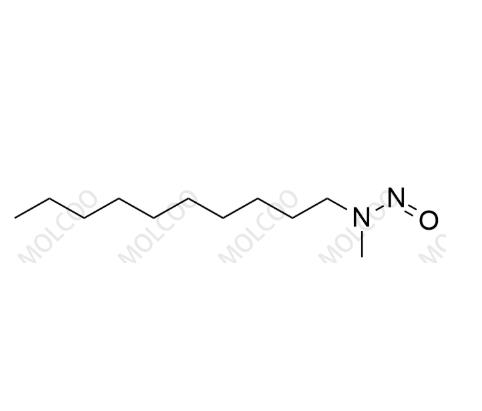
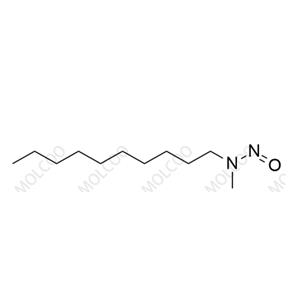
English Name: N-decyl-N-methylnitrous amide
English Alias: N-decyl-N-methylnitrous amide
CAS Number: 75881-22-0
Molecular Formula: C₁₁H₂₄N₂O
Molecular Weight: 200.32
As a nitrosamine compound, N-decyl-N-methylnitrous amide has the following characteristics:
Well-defined structure, which can be used as a standard reference for detecting nitrosamine impurities, helping to evaluate the content of nitrosamine contaminants in products such as pharmaceuticals and foods;
Good stability, maintaining its properties under normal storage conditions, providing a reliable standard for long-term testing and quality monitoring;
As a nitrosamine with a long-chain alkyl group, it can be used to study the effects of different carbon chain lengths on the toxicity and metabolic characteristics of nitrosamines.
Quality Control: Used as a standard for the calibration and validation of detection methods (e.g., HPLC, LC-MS/MS) for nitrosamine impurities in pharmaceuticals, foods, and cosmetics, ensuring products meet safety standards;
Toxicological Research: Serving as a model compound for in vitro cell experiments and animal models to explore the carcinogenic mechanisms and dose-response relationships of nitrosamines;
Environmental Monitoring: Applied to detect nitrosamine contaminants in environmental samples (such as water, soil, air) to assess pollution levels.
Nitrosamines are a class of known carcinogens widely present in food processing, drug synthesis, industrial production, and other processes. N-decyl-N-methylnitrous amide, as a long-chain alkyl derivative, may be generated in reaction systems containing amines and nitrosating agents or produced by nitrosation reactions during food processing (such as smoking and pickling). Due to its potential carcinogenic risk, regulatory authorities worldwide have set strict limits for nitrosamines in various products, making research on this compound an important part of ensuring public health and safety.
Current research focuses on:
Detection Technologies: Developing ultra-sensitive detection methods, such as high-resolution mass spectrometry (HR-MS) and rapid screening techniques, to achieve precise determination of trace amounts of N-decyl-N-methylnitrous amide (ppb or even ppt levels);
Formation Mechanisms: Studying the formation pathways of this compound in drug synthesis and food processing, exploring key influencing factors of nitrosation reactions (such as temperature, pH, catalyst);
Toxicological Mechanisms: Using techniques like gene sequencing and metabolomics to deeply analyze the molecular mechanisms by which it induces cell ;
Control Strategies: Developing technologies to remove or inhibit nitrosamine formation, such as adding antioxidants and optimizing processing techniques, to reduce nitrosamine content in products.




 China
China