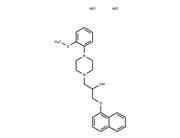
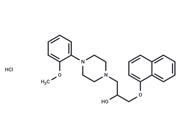
| Name | Naftopidil |
| Description | Naftopidil (KT-611) (INN, marketed under the brand name Flivas), an antihypertensive medicine, is used as a selective α1-adrenergic receptor antagonist or α-blocker. |
| In vitro | Naftopidil is selective for the alpha1d-adrenoceptor with approximately 3- and 17-fold higher affinity than for the alpha1a- and alpha1b-adrenoceptor subtypes, respectively. [1] Naftopidil has growth inhibitory effect in androgen-sensitive and -insensitive human prostate cancer cell lines. Naftopidil induces p21(cip1) but not p27(kip1) in PC-3 cells. [2] Naftopidil induces apoptosis in all the investigated malignant mesothelioma cells, and a similar effect is obtained with prazosin, another α1-adrenoceptor blocker. Naftopidil-induced reduction in cell viability is inhibited by GF109203X, while prazosin-induced in cell viability is less affected. [3] Naftopidil, an alpha 1-adrenoreceptor antagonist produces a concentration-dependent inhibition ofcollagen-induced Ca2+ mobilization, maximum inhibition (22.9%) occurring with 40 mM Naftopidil. Naftopidil also inhibits the adrenaline-induced rise in [Ca2+]i in a concentration-dependent manner (30 mM doxazosin), significant inhibitions of platelet aggregation also being produced. [4] Naftopidil (0.3, 1, and 3 μM) inhibits 5-HT-induced bladder contraction in a concentration-dependent manner. Naftopidil inhibits both the 5-HT(2A) and 5-HT(2) receptor agonists-induced bladder contractions. Naftopidil binds to the human 5-HT(2A) and 5-HT(2B) receptors with pKi values of 6.55 and 7.82, respectively. [5] |
| In vivo | Naftopidil selectively inhibits the phenylephrine-induced increase in prostatic pressure compared with mean blood pressure in the anesthetized dog model. [1] Naftopidil inhibits 5-HT-induced bladder contraction via blockade of the 5-HT(2A) and 5-HT(2B) receptors in rats. [5] |
| Storage | Powder: -20°C for 3 years | In solvent: -80°C for 1 year
Shipping with blue ice/Shipping at ambient temperature. |
| Solubility Information | H2O : < 1 mg/mL (insoluble or slightly soluble)
Ethanol : < 1 mg/mL (insoluble or slightly soluble)
DMSO : 76.92 mg/mL (195.98 mM), Sonication is recommended.
10% DMSO+40% PEG300+5% Tween 80+45% Saline : 2 mg/mL (5.1 mM), Sonication is recommended.
|
| Keywords | α1D-adrenergic receptor | α1B-adrenergic receptor | α1A-adrenergic receptor | prostatic | prostate | pressure | Naftopidil | KT611 | KT 611 | Inhibitor | inhibit | hyperplasia | canine | BM15275 | BM 15275 | Beta Receptor | AdrenergicReceptor | Adrenergic Receptor |
| Inhibitors Related | Trifluoperazine dihydrochloride | Mirtazapine | Octopamine hydrochloride | Gemfibrozil | Buflomedil hydrochloride | Dexmedetomidine hydrochloride | Isoprenaline hydrochloride | D-Mannitol | Mianserin hydrochloride | Trazodone hydrochloride | Atenolol | Doxepin hydrochloride |
| Related Compound Libraries | Failed Clinical Trials Compound Library | Bioactive Compound Library | Anti-Neurodegenerative Disease Compound Library | Pain-Related Compound Library | Membrane Protein-targeted Compound Library | Anti-Cancer Clinical Compound Library | Drug Repurposing Compound Library | Inhibitor Library | Anti-Cancer Approved Drug Library | Bioactive Compounds Library Max | GPCR Compound Library | Anti-Cancer Drug Library |



 United States