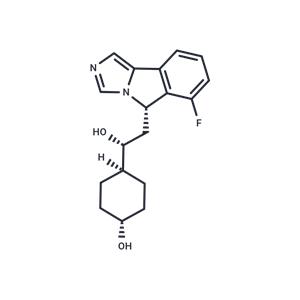
| Name | Navoximod |
| Description | Navoximod (GDC-0919) (NLG- 919, GDC-0919) is a potent indoleamine-(2,3)-dioxygenase (IDO) pathway inhibitor (Ki/EC50: 7 nM/75 nM). |
| Cell Research | Briefly, HeLa cells are seeded in a 96-well plate at a cell density of 5000 cells per well and allowed to grow overnight. Recombinant human IFN-γ is then added to each well with a final concentration of 50?ng/mL. At the same time, various concentrations of PEG2k-Fmoc-NLG(L), PEG2k-Fmoc-NLG(S) or Navoximod (NLG919) (50?nM-20?μM) are added to the cells. After 48?h of incubation, 150?μL of the supernatants per well is transferred to a new 96-well plate. Seventy-five μL of 30% trichloroacetic acid is added into each well and the mixture is incubated at 50°C for 30?min to hydrolyse N-formylkynurenine to kynurenine. For the colorimetric assay, supernatants are transferred to a new 96-well plate, mixed with an equal volume of Ehrlich reagent (2% p-dimethylamino-benzaldehyde w/v in glacial acetic acid), and incubated for 10?min at RT. The reaction product is measured at 490?nm by a plate reader [3]. |
| Animal Research | Mice are anesthetized with 4% isoflurane, and the surgical plane of anesthesia is maintained with 2% isoflurane in oxygen. Mice are immobilized in a stereotactic frame for tumor implantation. Briefly, the skull is shaved and exposed with a 0.5 cm skin incision. With the antiseptic technique, 10^5 GL261 cells (suspended in 3 μL RPMI-1640) are injected at the following coordinates with respect to the bregma on the right side (antero-posterior, -2 mm; medio-lateral, 2 mm; dorsoventral, 3 mm). This placement reproducibly yielded tumor growth in a paracortical area of the posterolateral right frontal lobe. Tumor-bearing mice are treated with combinations of oral DL-1MT (2 mg/mL D-1MT mixed with 2 mg/mL L-1MT) in drinking water, D-1MT (4 mg/mL) in drinking water, Navoximod (6 mg/mL) in drinking water, intraperitoneal cyclophosphamide, intraperitoneal temozolomide, and/or total-body radiation (500 cGy from a 137Cs source), as detailed in figure legends. Mice are observed daily and sacrificed when they became ill or moribund [2]. |
| In vitro | Navoximod potently blocks IDO-induced T cell suppression and restores robust T cell responses (ED50: 80 nM) using IDO-expressing human and mouse dendritic cells (DCs) in allogeneic mixed lymphocyte reaction (MLR) and in vitro models from tumor-draining lymph nodes (ED50: 120 nM) [1]. It inhibits IDO activity in a concentration-dependent manner (EC50: 0.95 μM). PEG2k-Fmoc-NLG(L) is less active (EC50: 3.4 μM) compared to Navoximod, while PEG2k-Fmoc-NLG(S) is the least active (EC50>10 μM). Coculture of IDO+ tumor cells with BALB/c mouse splenocytes shows significant inhibition of T-cell proliferation, which is attenuated by Navoximod. PEG2k-Fmoc-NLG(L) also reverses the inhibitory effect of tumor cells, albeit slightly less potently than Navoximod [3]. |
| In vivo | In mice, a single oral administration of Navoximod reduces the concentration of plasma and tissue Kyn by ~50%. In vivo, in mice bearing large established B16F10 tumors, administration of Navoximod markedly enhances the anti-tumor responses of na?ve, resting pmel-1 cells to vaccination with cognate hgp100 peptide plus CpG-1826 in IFA. In this stringent established-tumor model, Navoximod plus pmel-1/vaccine produces a dramatic collapse of tumor size within 4 days of vaccination (~95% reduction in tumor volume compared to control animals receiving pmel-1/vaccine alone without Navoximod) [1]. When combined with Temozolomide (TMZ)+radiation therapy (RT), both Navoximod and 1-methyl-D-tryptophan (D-1MT, indoximod) enhance survival relative to mice treated with TMZ+RT alone [2]. |
| Storage | Shipping with blue ice/Shipping at ambient temperature. |
| Solubility Information | 10% DMSO+40% PEG300+5% Tween 80+45% Saline : 4 mg/mL (12.64 mM), Sonication is recommended.
DMSO : 100 mg/mL (316.09 mM), Sonication is recommended.
|
| Keywords | NLG-919 | NLG919 | NLG-?919 | NLG 919 | Navoximod | Inhibitor | inhibit | Indoleamine2,3Dioxygenase(IDO) | Indoleamine2,3Dioxygenase | Indoleamine 2,3-Dioxygenase (IDO) | Indoleamine 2,3Dioxygenase (IDO) | Indoleamine 2,3-Dioxygenase | IDO | GDC0919 | GDC 0919 |
| Inhibitors Related | Palmatine chloride | GNF-PF-3777 | Necrostatin-1 | IDO-IN-7 | TDO-IN-1 | IDO1-IN-28 | Indoximod | Palmatine | Epacadostat | β-Lapachone | IDO-IN-12 | 3-TYP |
| Related Compound Libraries | Failed Clinical Trials Compound Library | Bioactive Compound Library | ReFRAME Related Library | Anti-Cancer Clinical Compound Library | Drug Repurposing Compound Library | Inhibitor Library | Metabolism Compound Library | Immuno-Oncology Compound Library | Immunology/Inflammation Compound Library | Bioactive Compounds Library Max | Anti-Cancer Drug Library | Anti-Cancer Active Compound Library |


 United States


