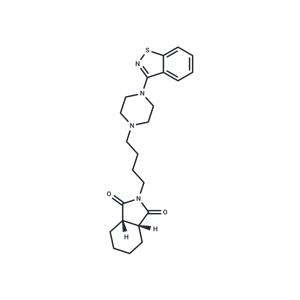
| Name | Perospirone |
| Description | Perospirone (Lullan) is an antagonist of serotonin 5HT2A receptors and dopamine D2 receptors. It also displays affinity towards 5HT1A receptors as a partial agonist. |
| Cell Research | Cell lines: Human neuroblastoma SK-N-SH cells. Concentrations: 10.5 or 105.5?nM.Cells are maintained in Eagle's minimal essential medium containing 10% fetal bovine serum for 8 days.The cells are exposed to either a high dose (105.5?nM,assigned as the "high-dose group") or low dose (10.5?nM,assigned as the "low-dose group") of perospirone.The concentrations are determined based on dosages typically used in the clinical setting.The medium is changed on days 2,5,and 8 with media containing perospirone,and on day 9,cells are harvested and processed. |
| Animal Research | Animal Models: Five-week-old male ICR mice. Formulation: 0.5% methylcellulose solution. Dosages: 10 mg/kg, p.o. |
| In vitro | In CHO cells expressing human 5-HT1A receptors, perospirone shows a high affinity (Ki: 0.72 nM) and exhibits partial agonistic efficacy[1]. Perospirone changes epigenetic profiles of neural genes. It can cause DNA methylation changes in cell cultures[2]. Perospirone is an inhibitor of Pgp which interferes directly and indirectly with the function of Pgp. The inhibition of Pgp by perospirone may cause clinically significant drug-drug interactions, especially in the tissue in which it accumulated[3]. |
| In vivo | Perospirone shows potent 5-HT2 and D2 receptor blocking activities in various animal models in vivo. Perospirone inhibits various dopaminergic behaviours (e.g. methamphetamine-induced hyperactivity and apomorphine-induced stereotypy or climbing behaviour) in rodents. It also inhibits the rat conditioned avoidance response. In behavioural tests, perospirone markedly inhibits serotonergic behaviour (e.g. tryptamine-induced clonic seizures, and p-chlorphenamine-induced hyperthermia) in rats. Perospirone has anxiolytic-like effects and mood stabilizing effects in various animal models. It inhibits motor coordination in a rota-rod test and potentiates the duration of hexobarbital-induced anaesthesia with ED50 values of 34 and 37 mg/kg (p.o.), respectively[1]. |
| Storage | Powder: -20°C for 3 years | In solvent: -80°C for 1 year | Shipping with blue ice/Shipping at ambient temperature. |
| Solubility Information | DMSO : 55 mg/mL (128.94 mM), Sonication is recommended.
|
| Keywords | SM-9018 | SM9018 | SM 9018 | Serotonin Receptor | schizophrenic | Perospirone | Orally | Inhibitor | inhibit | DopamineReceptor | Dopamine Receptor | Dopamine | disease | deficits | D2 | cognitive | atypical | antipsychotic | 5-hydroxytryptamine Receptor | 5HTReceptor | 5-HT2A | 5-HT1A | 5-HT Receptor | 5HT Receptor |
| Inhibitors Related | Trifluoperazine dihydrochloride | Alverine citrate | Dapoxetine hydrochloride | Cefaclor monohydrate | Clozapine N-Oxide | Octopamine hydrochloride | 1,8-Cineole | L-DOPA | Creatine | Oxolinic acid | Mianserin hydrochloride | Trazodone hydrochloride |
| Related Compound Libraries | Bioactive Compound Library | Pain-Related Compound Library | Anti-Neurodegenerative Disease Compound Library | Membrane Protein-targeted Compound Library | Drug Repurposing Compound Library | Inhibitor Library | Anti-Cancer Approved Drug Library | Orally Active Compound Library | Bioactive Compounds Library Max | GPCR Compound Library | Serotonin Receptor-Targeted Compound Library | Anti-Cancer Drug Library |


 United States