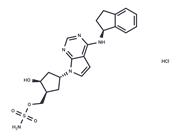
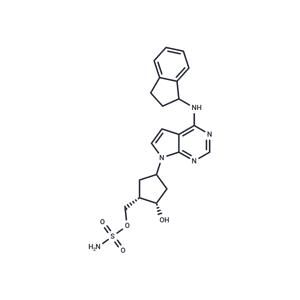
| Name | Pevonedistat |
| Description | Pevonedistat (MLN4924) is a potent and selective NEDD8 activating enzyme (NAE) inhibitor (IC50=4.7 nM) with therapeutic potential for myelodysplastic syndromes (MDS) and antitumor activity. |
| Cell Research | MLN4924 is dissolved in DMSO and stored, and then diluted with appropriate medium before use[1]. HCT-116 cells grown in 6-well cell-culture dishes are treated with 0.1% DMSO (control) or 0.3 μM MLN4924 for 24 h. Whole cell extracts are prepared and analysed by immunoblotting. For analysis of the E2-UBL thioester levels, lysates are fractionated by non-reducing SDS-PAGE and immunoblotted with polyclonal antibodies to Ubc12, Ubc9 and Ubc10. For analysis of other proteins, lysates are fractionated by reducing SDS-PAGE and probed with primary antibodies as follows: mouse monoclonal antibodies to CDT1, p27, geminin, ubiquitin, securin/PTTG and p53 or rabbit polyclonal antibodies to NRF2, Cyclin B1 and GADD34[1]. |
| Kinase Assay | Bcl-2 Binding affinity calculation: A predicted binding affinity for Obatoclax binding to BCL-2 is calculated using the SIE scoring function. [4] As a control in determining the reliability of the calculation, predicted binding affinities Ki) are calculated for a set of 12 small molecules with experimentally measured binding affinities to BCL-2. |
| In vitro | METHODS: Nine neuroblastoma cell lines were treated with Pevonedistat (12-1000 nM) for 72 h. Cell viability was measured by MTT.
RESULTS: All neuroblastoma cell lines tested were sensitive to Pevonedistat with IC50 values ranging from 136-400 nM. [1]
METHODS: Human colorectal cancer cells HCT-116 were treated with Pevonedistat (0.001-3 μM) for 24 h, and the expression levels of target proteins were detected by Western Blot.
RESULTS: Pevonedistat treatment resulted in a dose-dependent decrease in Ubc12-NEDD8 thioester and NEDD8-cullin couplings, leading to an increase in the abundance of known CRL substrates CDT1, p27 and NRF2. [2] |
| In vivo | METHODS: To detect anti-tumor activity in vivo, Pevonedistat (30-60 mg/kg in 10% cyclodextrin) was injected subcutaneously into BALB/c mice harboring the human colorectal cancer tumor HCT-116 either once or twice daily for twenty days.
RESULTS: Pevonedistat inhibited the growth of HCT-116 xenograft tumors. [2]
METHODS: To assay in vivo antitumor activity, Pevonedistat (60 mg/kg, intraperitoneal injection, once daily), venetoclax (50 mg/kg, oral administration, once daily), and azacitidine (8 mg/kg, intravenously three times every seven days) were administered to NSGS mice harboring the AML tumor OCI-AML2-Red- Fluc for fourteen days.
RESULTS: Pevonedistat/venetoclax/azacitidine triple therapy induced durable responses in a systemic xenograft model of acute myeloid leukemia. [3] |
| Storage | Powder: -20°C for 3 years | In solvent: -80°C for 1 year
Shipping with blue ice/Shipping at ambient temperature. |
| Solubility Information | DMSO : 62.5 mg/mL (140.92 mM), Sonication is recommended.
10% DMSO+40% PEG300+5% Tween 80+45% Saline : 2 mg/mL (4.51 mM), Sonication is recommended.
|
| Keywords | Pevonedistat | NEDD8-activating Enzyme | NEDD8 | NAE | MLN-4924 | MLN 4924 | Inhibitor | inhibit | E3Enzyme | E3 Enzyme | E2Enzyme | E2 Enzyme | E1Enzyme | E1 Enzyme |
| Inhibitors Related | Stavudine | Aceglutamide | Urea | Tamoxifen | Cysteamine hydrochloride | Metronidazole | Citric Acid Triammonium | Formamide | Dimethyl phthalate | Alginic acid | Sodium Molybdate | Sildenafil citrate |
| Related Compound Libraries | Failed Clinical Trials Compound Library | Bioactive Compound Library | HIF-1 Signaling Pathway Compound Library | ReFRAME Related Library | Anti-Cancer Clinical Compound Library | Drug Repurposing Compound Library | Inhibitor Library | NO PAINS Compound Library | Metabolism Compound Library | Bioactive Compounds Library Max | Anti-Cancer Drug Library | Anti-Cancer Active Compound Library |


 United States