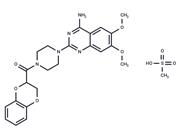
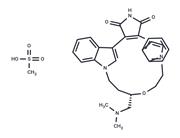
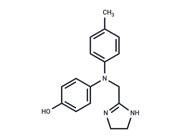
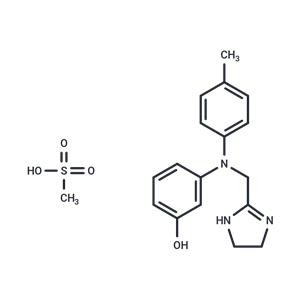
| Name | Phentolamine mesylate |
| Description | Phentolamine mesylate (Phentolamine methanesulfonate) is a nonselective alpha-adrenergic antagonist used to treat hypertension and hypertensive emergencies, pheochromocytoma, vasospasm of [RAYNAUD DISEASE] and frostbite, clonidine withdrawal syndrome, impotence, and peripheral vascular disease. |
| In vitro | Phentolamine mesylate displaces binding of the selective alpha 1 receptor antagonists [125I]HEAT and [3H]prazosin and the alpha 2 receptor antagonists [3H]rauwolscine and [3H]RX 821002 with relatively high affinity in corpus cavernosum membranes. Phentolamine mesylate causes concentration dependent relaxation in erectile tissue strips pre-contracted with adrenergic agonists phenylephrine, norepinephrine, oxymetazoline and UK 14,304, as well as with non-adrenergic contractile agents Endothelin and KCl. Phentolamine mesylate induces relaxation of corpus cavernosum erectile tissue by direct antagonism of alpha 1 and 2 adrenergic receptors and by indirect functional antagonism via a non-adrenergic, endothelium-mediated mechanism suggesting nitric oxide synthase activation. [1] Phentolamine, an alpha-adrenergic antagonist, blocks the vasoconstriction associated with the epinephrine used in dental anesthetic formulations, thus enhancing the systemic absorption of the local anesthetic from the injection site. [2] |
| In vivo | Phentolamine is a reversible competitive alpha-adrenergic antagonist with similar affinities for alphal and alpha2 receptors. Phentolamine mesylate causes vasodilatation and thus hypotension by decreasing peripheral vascular resistance. [4] Phentolamine mesylate (30 and 100 nM) dose-dependently enhances electrical field stimulation-induced relaxation of the rabbit corpus cavernosum. Phentolamine relaxes rabbit corpus cavernosum independent of alpha-adrenergic receptor blockade. Phentolamine mesylate relaxes nonadrenergic noncholinergic neurons of the rabbit corpus cavernosum by activating NO synthase and is independent of alpha-adrenergic receptor blockade. [5] |
| Storage | Powder: -20°C for 3 years | In solvent: -80°C for 1 year
Shipping with blue ice/Shipping at ambient temperature. |
| Solubility Information | H2O : 37.8 mg/mL (100.14 mM), Sonication is recommended.
DMSO : 60 mg/mL (158.96 mM), Sonication is recommended.
10% DMSO+90% Corn Oil : 2.5 mg/mL (6.62 mM), Sonication is recommended.
|
| Keywords | α-adrenergic receptor | vessels | vascular | resistance | pheochromocytoma | Phentolamine mesylate | Phentolamine | peripheral | Inhibitor | inhibit | hypertension | heart | failure | erectile | dysfunction | blood | Beta Receptor | AdrenergicReceptor | Adrenergic Receptor | adrenergic |
| Inhibitors Related | Trifluoperazine dihydrochloride | Mirtazapine | Octopamine hydrochloride | Gemfibrozil | Buflomedil hydrochloride | Dexmedetomidine hydrochloride | Isoprenaline hydrochloride | D-Mannitol | Mianserin hydrochloride | Trazodone hydrochloride | Atenolol | Doxepin hydrochloride |
| Related Compound Libraries | Anti-Neurodegenerative Disease Compound Library | Bioactive Compound Library | Membrane Protein-targeted Compound Library | Anti-Cancer Clinical Compound Library | Anti-Viral Compound Library | Drug Repurposing Compound Library | Inhibitor Library | Anti-Cancer Approved Drug Library | FDA-Approved Drug Library | Bioactive Compounds Library Max | GPCR Compound Library | Anti-Cancer Drug Library |


 United States