NanoActive® 377: The Revolutionary Nano High-Efficiency Whitening Solution
Introduction: The Perfect Fusion of Science & Technology
In the dynamic and ever-evolving landscape of cosmetic science, the pursuit for effective, safe, and stable skin-lightening ingredients is relentless. Standing at the forefront of this innovation is PuriPharm Co. Ltd., a pioneer dedicated to the innovation and application of nano-biotechnology. Under its distinguished PuriActives® and NanoActive® brand series, PuriPharm has introduced a breakthrough ingredient that redefines the standards of melanin inhibition and skin brightening: NanoActive® 377.
NanoActive® 377 represents the perfect synergy between nature’s wisdom and cutting-edge nanotechnology. It addresses the historical challenges of skin whitening by combining the potent efficacy of Phenylethyl Resorcinol with an advanced Nano Delivery System (NDS). This product introduction delves into the science, the technology, and the proven efficacy that make NanoActive® 377 the ultimate choice for formulators seeking to create high-performance brightening and anti-aging skincare products.
Inspiration from Nature: The Evolution of 377
The story of NanoActive® 377 begins in the heart of the forest, drawing inspiration from the Evergreen Conifer (Pinus sylvestris). Nature has long provided the blueprint for effective active ingredients, and in this case, the inspiration is Pinosylvin, a natural whitening agent found in pine trees.
However, while natural ingredients are desirable, they often lack the potency or stability required for cosmetic formulations. Through rigorous scientific optimization, researchers developed a synthetic analogue of Pinosylvin: Phenylethyl Resorcinol, commonly known in the industry as 377.
This evolution represents a significant leap in cosmetic chemistry:
Origin: Pinosylvin (Natural)
Process: Structural Modification
Result: 377 (High-Efficiency Synthetic)
By retaining the core structural benefits of the natural molecule while enhancing its stability and activity, 377 was born. It is widely recognized today as one of the most effective non-toxic tyrosinase inhibitors available, positioning it as a “potent yet safe” alternative to harsh traditional agents.
Understanding the Challenge: The Melanogenesis Mechanism & Market Limitations
To appreciate the value of NanoActive® 377, one must first understand the mechanism of skin pigmentation. Melanogenesis is the process by which skin produces melanin. It is a complex biological cascade:
Stimulus: Ultraviolet (UV) radiation stimulates keratinocytes to secrete signaling molecules, such as α-MSH.
Signal Transduction: These signals bind to receptors on melanocytes, activating internal pathways.
Key Target: The critical rate-limiting enzyme in this process is Tyrosinase. This enzyme catalyzes the conversion of tyrosine to DOPA, which is subsequently oxidized to become melanin.
Inhibiting Tyrosinase is the most effective strategy for controlling pigmentation. However, the market has been plagued by the limitations of traditional whitening agents:
Hydroquinone: Once the gold standard, it is now highly restricted or banned due to high cytotoxicity and the risk of ochronosis (permanent skin darkening).
Kojic Acid: While popular, it is easily oxidized and discolored, has poor photostability, and carries a risk of skin sensitization.
Arbutin: Known for being relatively gentle, it suffers from weak efficacy, slow onset of action, and potential hydrolysis issues.
Vitamin C: A potent antioxidant, but it is highly unstable, can cause skin irritation at high concentrations, and has a tendency to stain the skin yellow.
Even raw Phenylethyl Resorcinol (377) itself, despite its potency, faces application pain points:
Poor Solubility: It is difficult to dissolve in water, limiting its use in aqueous or serum formulations.
Discoloration: Like Kojic Acid, it is easily oxidized upon exposure to air and light, turning pink or brown.
Low Bioavailability: Its molecular structure struggles to penetrate the stratum corneum barrier to reach the basal melanocytes where it is needed most.
The Solution: NanoActive® Nano-Encapsulation Technology (NDS)
PuriPharm’s NanoActive® series was specifically designed to solve the stability and bioavailability issues inherent in active ingredients. For 377, this technology is a game-changer.
Core Technology:
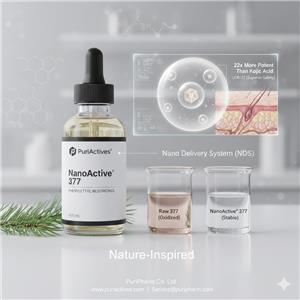
NanoActive® 377 utilizes a proprietary Nano Delivery System (NDS). This system stably encapsulates the Phenylethyl Resorcinol molecule within nano-carriers. This encapsulation acts as a protective shield, isolating the active ingredient from oxygen and light.
Physical Properties:
Particle Size: The particles are reduced to less than 30nm.
Appearance: The dispersion is clear and transparent, avoiding the cloudiness often associated with other carriers.
Stability: It is thermodynamically stable, ensuring a long shelf life.
Composition (INCI):
Phenylethyl Resorcinol, Tocopheryl Acetate, Phospholipids, Caprylic/Capric Triglyceride, Glycerin, Aqua.
The Four Advantages of Nano-Encapsulation:
Superior Stability: The nano-carrier effectively isolates the 377 from environmental stressors, completely solving the issues of oxidation and discoloration that plague raw 377.
High Penetration: With a particle size of <30nm, the active ingredient can effortlessly penetrate the stratum corneum to reach the basal layer where melanocytes reside.
High Bioavailability: The nano-structure allows for long skin retention times, significantly increasing absorption efficiency compared to raw powder.
Formulation Friendly: The NDS makes 377 amphiphilic (soluble in both water and oil), making it incredibly easy to incorporate into various formulations without complex heating or dissolving processes.
Mechanism of Action (MOA): Precise Targeting
NanoActive® 377 does not rely on a single mechanism to whiten the skin; it employs a dual-action approach for maximum efficacy.
1. Competitive Enzyme Inhibition (The “Lock & Key” Model):
The resorcinol structure of 377 mimics tyrosine, the natural substrate of the tyrosinase enzyme. Because of this structural similarity, 377 fits precisely into the active pocket of the tyrosinase enzyme. Furthermore, it chelates the copper ions essential for the enzyme’s function. This effectively causes the enzyme to “jam,” preventing it from converting tyrosine into melanin.
2. Antioxidant Blockade:
Beyond simple enzyme inhibition, Phenylethyl Resorcinol possesses powerful antioxidant capabilities. It effectively scavenges Reactive Oxygen Species (ROS) and blocks oxidative stress-induced pigmentation signals. This is crucial because UV damage often triggers pigmentation via oxidative pathways, independent of direct enzyme activity.
Authoritative Efficacy Data: Proof of Performance
The efficacy of NanoActive® 377 is backed by rigorous *in vitro* and clinical testing.
In Vitro Tyrosinase Inhibition:
Comparative studies have shown that Phenylethyl Resorcinol exhibits 22x the activity of Kojic Acid. This places it in the highest tier of tyrosinase inhibitors, capable of delivering visible results at lower concentrations.
Safety Ratio (LCR):
Safety is paramount in skincare. The LCR (Lightening Efficacy/Cytotoxicity Ratio) is a critical metric. NanoActive® 377 boasts an LCR of 72, which is far superior to Hydroquinone (LCR=1). This confirms that 377 achieves its high whitening efficiency without compromising cell safety.
3D Human Skin Model (MelanoDerm™):
In tests using a 3D human skin model (Type IV Skin), a concentration of just 0.5% NanoActive® 377 significantly reduced melanin content, outperforming a 1.0% concentration of Kojic Acid. Furthermore, MTT assays confirmed 100% cell viability after 14 days, proving that the whitening effect is purely biochemical and not due to cytotoxicity (cell killing).
Clinical Testing I: Skin Brightening (Non-Irradiated)
Subjects: 12 Asian Subjects (Type III Skin).
Duration: 28 Days, twice daily application on back skin.
Results: Measured by ΔL* (where higher values indicate lighter skin), 0.5% 377 demonstrated a superior brightening effect compared to 1.0% Kojic Acid. The study concluded that direct addition of NanoActive® 377 to a formula works exceptionally well.
Clinical Testing II: Anti-Melasma & Photoaging
Challenge: Treating mild to moderate facial melasma without Hydroquinone.
Duration: 12 Weeks.
Results: There was a significant reduction in spot area and pigmentation intensity.
Tolerance: The formulation showed excellent tolerance with no stinging or peeling, solidifying 377’s position as a safe alternative for treating hyperpigmentation.
More Than Whitening: Superior Antioxidant Power
While its primary claim to fame is tyrosinase inhibition, NanoActive® 377 offers comprehensive skincare benefits. Phenylethyl Resorcinol is a potent antioxidant that scavenges ROS and protects cells from UV damage.
This translates to multiple benefits for the end-user:
Reduction of UV-induced erythema (redness).
Anti-aging effects by reducing oxidative stress that leads to wrinkles.
Protection of other ingredients within the formulation from oxidation, acting as a stabilizer for the whole product.
Formulation Guidelines: Designed for Formulators
NanoActive® 377 is engineered to be formulator-friendly. Whether creating a serum, cream, or lotion, it offers versatility and ease of use.
Basic Parameters:
Recommended Dosage: 0.1% - 5.0%. Lower concentrations (0.1-0.5%) are ideal for daily brightening and maintenance, while higher concentrations (1.0-5.0%) are recommended for potent spot removal and treatment products.
pH Range: 4.0 - 5.0 (Suggested range 3.0 - 6.5). It is most stable in a weak acidic environment.
Processing: Due to its amphiphilic nature, it is soluble in both water and oil. It should be added at a low temperature (< 45°C) with homogenization to ensure even distribution.
Stability & Compatibility:
Avoid (DON’Ts): Avoid using thickeners that are unstable at low pH, such as Carbomer.
Recommend (DOs): Use Xanthan Gum or AVC (Ammonium Acryloyldimethyltaurate/VP Copolymer) for thickening. To maximize stability, use opaque packaging and add UV absorbers. It is also highly recommended to include a chelating agent like EDTA-2Na (0.05-0.1%).
Synergy: NanoActive® 377 works synergistically with other active ingredients such as Bisabolol (soothing) and Vitamin C derivatives (brightening/antioxidant).
Conclusion: Crystallization of Science & Technology
In a crowded market of whitening ingredients, NanoActive® 377 stands out as a testament to the power of PuriPharm Co. Ltd.’s R&D capabilities. It is the crystallization of scientific understanding and technological application.
By combining Phenylethyl Resorcinol—one of the most effective tyrosinase inhibitors—with a proprietary Nano-Encapsulation (NDS) system, PuriPharm has solved the industry’s toughest challenges: stability, penetration, and safety.
NanoActive® 377 offers:
Nano Tech Penetration: Direct delivery to the basal layer via NDS.
22x Whitening Potency: Superior efficiency compared to Kojic Acid.
Nature Inspired: A derivative of the Evergreen Conifer essence.
Precise Spot Fading: The ability to even skin tone and fight stubborn spots safely.
For formulators looking to create the next generation of skincare products, NanoActive® 377 provides the reliability, efficacy, and safety profile required for success. It is not just an ingredient; it is a comprehensive solution for modern, high-performance skincare.
*About PuriPharm Co. Ltd.*
PuriPharm Co. Ltd. is dedicated to the innovation and application of nano-biotechnology. Through its PuriActives® and NanoActive® series, the company continues to provide the cosmetic industry with groundbreaking ingredients that meet the highest standards of safety and efficacy.
www.puriactives.com | Service@puripharm.com


 China
China