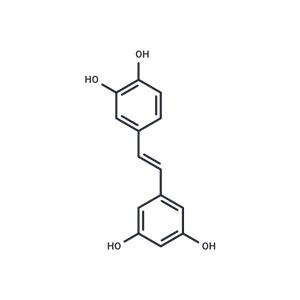
| Name | Piceatannol |
| Description | Piceatannol (Astringenin) is an anti-inflammatory, immunomodulatory and antiproliferative agent. It inhibits p56lck and syk protein tyrosine kinases and inhibits NF-κB activation and gene expression of TNF-induced. It is synthetic from the conversion of resveratrol by cytochrome P450 1B1. |
| Cell Research | Cells are exposed to increasing concentrations of Piceatannol. For the determination of cell proliferation, cells are assayed at 72 hours by trypan blue exclusion using a hemocytometer. After 1 week, colonies are stained with 1.25% crystal violet and quantified by measuring the absorbance at 595 nm. (Only for Reference) |
| Kinase Assay | In Vitro Protein-tyrosine Kinase Assays: Recombinant Syk is expressed in baculovirus-infected St9 cells. Assays of recombinant Syk activity are carried out using angiotensin I peptide as substrate. The enzyme activities of recombinant Syk are measured by phosphorylation of angiotensin I peptide in the presence of various concentrations of Piceatannol. |
| In vitro | In mast cells, Piceatannol is an effective inhibitor of histamine release, selectively suppressing Syk to block receptor-mediated cellular responses, including inhibition of 1,4,5-IP3 secretion, synthesis, membrane ruffling, and transportation. Piceatannol inhibits Syk activity approximately tenfold more potently than Lyn. When RBL-2H3 cells are treated with Piceatannol, antigen-stimulated phosphorylation of Syk and most other cellular proteins is strongly inhibited. However, it doesn’t affect the phosphorylation of receptor gamma or beta subtypes, presenting a dose-dependent inhibition. Piceatannol also effectively inhibits CDPK, MLCK, PKC, and PKA, with IC50 values of 19 μM, 12 μM, 8 μM, and 3 μM respectively. It selectively inhibits IFNα-induced tyrosine phosphorylation of STAT3/5 without affecting STAT1/2 and selectively inhibits the dephosphorylation of tyrosine on Jak1 and IFNAR1, not affecting Tyk2 and IFNAR2. Piceatannol induces apoptosis in BJAB Burkitt-like lymphoma cells via the activation of caspase-3 and changes in mitochondrial permeability, with an ED50 of 25 μM, independent of the CD95/Fas signaling pathway. It inhibits NF-κB activation induced by TNF, H2O2, PMA, lipopolysaccharides, okadaic acid, and ceramide. Specifically, it inhibits TNF-induced expression of NF-κB-dependent reporter genes (matrix metalloproteinase-9, cyclooxygenase-2, and cyclin D1) by blocking TNF-induced IκBαof phosphorylation, p65 nuclear translocation, and IκB kinase activation, independent of tyrosine kinase. Piceatannol binds to intracellular phosphatidylinositol kinase in an ATP-competitive manner, inhibiting its activity and exhibiting anti-atherosclerotic effects superior to resveratrol. Lastly, Piceatannol suppresses the proliferation of both androgen-dependent and -independent CaP cells and notably reduces the expression of mTOR and its key effectors AKT and eIF4EBP-1. |
| In vivo | Oral administration of Piceatannol significantly ameliorates structural damage to the colon in BALB/c mice with dextran sulfate sodium-induced colitis, markedly reducing the production of inflammatory mediators (such as nitric oxide, prostaglandin E2, and pro-inflammatory cytokines), and notably diminishes colonic myeloperoxidase (MPO) activity. In type 2 diabetic db/db mouse models, Piceatannol suppresses early elevation of blood glucose levels and improves impaired glucose tolerance in later stages. |
| Storage | Powder: -20°C for 3 years | In solvent: -80°C for 1 year | Shipping with blue ice. |
| Solubility Information | Ethanol : 24.4 mg/mL (99.9 mM), Sonication is recommended.
DMSO : 160 mg/mL (655.09 mM), Sonication is recommended.
|
| Keywords | threoninkinase | threonin kinase | Syk | Serinekinase | Serine kinase | PKC | Piceatannol | MLCK | iNOS | injury | cAK | Autophagy | Apoptosis | ALI |
| Inhibitors Related | Stavudine | Sodium 4-phenylbutyrate | L-Ascorbic acid | Hydroxychloroquine | Guanidine hydrochloride | L-Glutamic acid | Tributyrin | Valproic Acid | Paeonol | Naringin | L-Ascorbic acid sodium salt | Gefitinib |
| Related Compound Libraries | Traditional Chinese Medicine Monomer Library | Membrane Protein-targeted Compound Library | Kinase Inhibitor Library | Selected Plant-Sourced Compound Library | Miao medicine Compound Library | Tobacco Monomer Library | Inhibitor Library | Natural Product Library for HTS | Immunology/Inflammation Compound Library | Anti-Aging Compound Library | Anti-Cancer Active Compound Library | TGF-beta/Smad Compound Library |


 United States