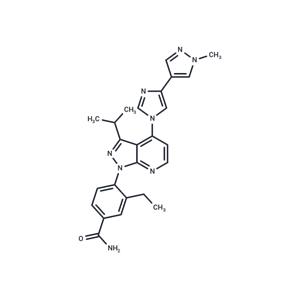
| Name | Pimitespib |
| Description | Pimitespib (TAS-116) is an ATP-competitive and highly specific HSP90α/HSP90β inhibitor with inhibition constants (Kis) of 34.7 nM and 21.3 nM, respectively. |
| In vitro | Pimitespib binds not only to the conventional-binding pockets as existing Hsp-90 inhibitors but also to a novel-binding pocket. Such a unique binding mode makes Pimitespib highly specific for Hsp-90α/β. Pimitespib (0-5 μM, 48 hours) inhibits human retinal pigment epithelial ARPE-19 cell lines and NCI-H929 MM cell growth. Compared 17-AAG in INA6 and NCI-H929 MM cells, more significant degradation of p-C-Raf and p-MEK1/2, HSP90 client proteins, and key RAS/RAF/MEK pathway regulators, is triggered by Pimitespib (0.125-1 μM, 24 hours) [2][3]. |
| In vivo | TAS-116 is orally absorbed and has a bioavailability of almost 100% in mice, and 69.0% in rats. TAS-116 has moderate terminal elimination half-life (t1/2=8.2 h, 2.5 h, 4.4 h and 2.2 h for mouse (3.6 mg/kg, p.o.), mouse (7.1 mg/kg, p.o.), mouse (14.0 mg/kg, p.o.), rat (4 mg/kg, p.o.)). TAS-116 is more rapidly eliminated from retina (t1/2=3.4 hours) than the other HSP90 inhibitors (t1/2=7.1-19.1 hours). TAS-116 is distributed less in retina than in plasma in rats; consequently, TAS-116 does not produce any detectable photoreceptor injury. TAS-116 triggers enhanced in vivo anti-MM activities, both alone and in combination with Bortezomib (BTZ), with a favorable safety profile. TAS-116 (12.0 mg/kg, p.o., 14 days) displays antitumor activity without inducing eye injury in rats. Mice treated with TAS-116 (10 mg/kg and 15 mg/kg, orally, 38 days), BTZ, or TAS-116 plus BTZ show significantly enhance growth inhibition versus the vehicle control group. Median overall survival of treated animals (TAS-116, orally, 10 mg/kg=33 days, 15 mg/kg=37 days, BTZ=36 days, and the combination=56.5 days) is significantly longer than vehicle control. The favorable pharmacokinetic profile of TAS-116 is reflected in its dose-dependent antitumor activity; the T/C (tumor volume of TAS-116-treated mice vs. vehicle-treated mice) is 47%, 21%, and 9% for doses of 3.6 mg/kg, 7.1 mg/kg, and 14.0 mg/kg, respectively [1][2]. |
| Storage | Powder: -20°C for 3 years | In solvent: -80°C for 1 year
Shipping with blue ice/Shipping at ambient temperature. |
| Solubility Information | 10% DMSO+40% PEG300+5% Tween 80+45% Saline : 4 mg/mL (8.8 mM), Sonication is recommended.
DMSO : 50 mg/mL (110 mM), Sonication is recommended.
|
| Keywords | TAS116 | TAS 116 | Pimitespib | Inhibitor | inhibit | HSP90β | HSP90α | HSP | Heat shock proteins |
| Inhibitors Related | Ethoxyquin | Adezmapimod | Tamoxifen | Palmitic acid sodium | Mequinol | 7-Aminocephalosporanic acid | Benzbromarone | Elesclomol | Rifabutin | Palmitic acid | Tamoxifen Citrate | Isoxazole |
| Related Compound Libraries | Bioactive Compound Library | Membrane Protein-targeted Compound Library | Anti-Breast Cancer Compound Library | Anti-Cancer Clinical Compound Library | Drug Repurposing Compound Library | Inhibitor Library | Metabolism Compound Library | Clinical Compound Library | Bioactive Compounds Library Max | Anti-Cancer Compound Library | Anti-Cancer Drug Library | Anti-Cancer Active Compound Library |


 United States