Human Prolactin R / PRLR Protein, His Tag
Synonym
Prolactin R, PRLR, PRL-R
Source
Human Prolactin R, His Tag (PRR-H52Ha) is expressed from human 293 cells (HEK293). It contains AA Gln 25 - Asp 234 (Accession # P16471-1).
Predicted N-terminus: Gln 25
Molecular Characterization

This protein carries a polyhistidine tag at the C-terminus.
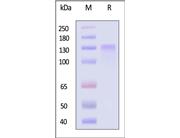
The protein has a calculated MW of 26.3 kDa. The protein migrates as 30-35 kDa when calibrated against Star Ribbon Pre-stained Protein Marker under reducing (R) condition (SDS-PAGE) due to glycosylation.
Endotoxin
Less than 1.0 EU per μg by the LAL method / rFC method.
Purity
>95% as determined by SDS-PAGE.
Formulation
Lyophilized from 0.22 μm filtered solution in 50 mM Tris, 150 mM NaCl, pH7.5 with trehalose as protectant.
Contact us for customized product form or formulation.
Reconstitution
Please see Certificate of Analysis for specific instructions.
For best performance, we strongly recommend you to follow the reconstitution protocol provided in the CoA.
Storage
For long term storage, the product should be stored at lyophilized state at -20°C or lower.
Please avoid repeated freeze-thaw cycles.
This product is stable after storage at:
-20°C to -70°C for 12 months in lyophilized state;
-70°C for 3 months under sterile conditions after reconstitution.
Background
As a transmembrane receptor, the prolactin receptor (PRL-R) interacts with prolactin. In addition, the PRL-R also binds and is activated by growth hormone (GH) and human placental lactogen (hPL). Preclinical investigations, epidemiological studies and analyses of tissue specimens from patients strongly support the contribution of prolactin receptor (PRLR) signaling to breast and prostate tumorigenesis and cancer progression. Moreover, The PRLR has been found to be essential for lobuloalveolar maturation of the mammary glands during pregnancy, as evidenced by the fact that PRLR knockout mice show severely impaired development of lobuloalveolar structures.




 China
China