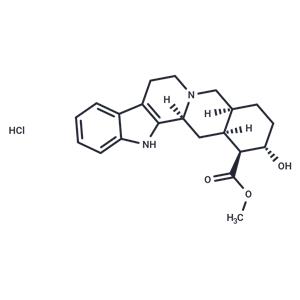
| Name | Rauwolscine hydrochloride |
| Description | Rauwolscine hydrochloride (Isoyohimbine hydrochloride) , a natural alkaloid, is a specific and reversible α2-adrenergic receptor antagonist (Ki: 12 nM) [1]. It is a stereoisomer of yohimbine, which potently antagonizes both α1- and α2-adrenergic receptors [1]. Rauwolscine hydrochloride also acts as a receptor antagonist at the serotonin 5-HT2B receptor (Ki: 14.3 nM) and as a weak partial agonist at 5-HT1A (IC50: 1.3 μM) [3]. The α2-adrenergic receptor has diverse physiological functions and antagonists like rauwolscine have numerous applications, including the modulation of mood and behavior [5]. |
| Kinase Assay | Fresh bovine frontal cortex is incubated in triplicate with [3H]Rauwolscine (82 Ci/mM, diluted). Incubation is terminated by filtration under reduced pressure over filters, which are then rinsed with ice-cold Tris-HCl buffer, dried overnight and added to disposable glass mini vials containing 3.0 mL of a 95% Econofluor/5% Protocol solution. Samples are counted by liquid scintillation spectrometry with an efficiency of 32%. (-)- [3H]Epinephrine binding to bovine cortex membranes is conducted at 25°C[1]. |
| In vitro | [3H]Rauwolscine binding to the α2 adrenergic receptor is reversible, stcreospccific, and saturable. [3H]Rauwolscine specifically labels both the high and low-affinity states of the α2 adrenergic receptor in brain membranes[1]. [3H]Rauwolscine also behaves as a 5-HT1A receptor agonist, indicating that rauwolscine (as well as yohimbine) has agonistic properties at the level of 5-HT autoreceptors[2]. When using [3H]5-HT as a radioligand, rauwolscine is determined to have a relatively high affinity for the human receptor (Ki: 14.3/35.8 nM, for human and rat)[3]. Saturation studies show that the affinity of [3H]Rauwolscine is similar in mouse, rabbit, rat, dog (2.33-3.03 nM) except man where it is significantly higher (0.98 nM) [4]. |
| Storage | Shipping with blue ice/Shipping at ambient temperature. |
| Solubility Information | DMSO : 13.51 mg/mL (34.56 mM), Sonication is recommended.
H2O : 5 mM, Heating is recommended.
|
| Keywords | α-Yohimbine Hydrochloride | α-Yohimbine | α2 adrenergic receptor | Rauwolscine hydrochloride | Rauwolscine | Isoyohimbine Hydrochloride | Isoyohimbine | Inhibitor | inhibit | Corynanthidine Hydrochloride | Corynanthidine | Beta Receptor | a-Yohimbine Hydrochloride | alpha-Yohimbine Hydrochloride | AdrenergicReceptor | Adrenergic Receptor |
| Inhibitors Related | Trifluoperazine dihydrochloride | Mirtazapine | Octopamine hydrochloride | Gemfibrozil | Buflomedil hydrochloride | Dexmedetomidine hydrochloride | Isoprenaline hydrochloride | D-Mannitol | Mianserin hydrochloride | Trazodone hydrochloride | Atenolol | Doxepin hydrochloride |
| Related Compound Libraries | Anti-Tumor Natural Product Library | Anti-Neurodegenerative Disease Compound Library | Bioactive Compound Library | Alkaloid Natural Product Library | Membrane Protein-targeted Compound Library | Selected Plant-Sourced Compound Library | Natural Product Library | Inhibitor Library | Anti-Cardiovascular Disease Compound Library | Natural Product Library for HTS | Bioactive Compounds Library Max | GPCR Compound Library |


 United States