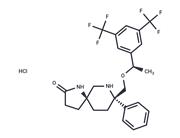
| Name | Rolapitant |
| Description | Rolapitant (SCH619734) Hydrochloride is the hydrochloride salt form of rolapitant, an orally bioavailable, centrally-acting, selective, neurokinin 1 receptor (NK1-receptor) antagonist with potential antiemetic activity. Upon oral administration, rolapitant competitively binds to and blocks the activity of the NK1-receptor in the central nervous system, thereby inhibiting the binding of the endogenous ligand, substance P (SP). This may prevent both SP-induced emesis and chemotherapy-induced nausea and vomiting (CINV). The interaction of SP with the NK1-receptor plays a key role in the induction of nausea and vomiting caused by emetogenic cancer chemotherapy. Compared to other NK1-receptor antagonists, rolapitant has both a more rapid onset of action and a much longer half-life. |
| Kinase Assay | Rolapitant is made at a stock concentration of 1 mM in 100% DMSO. For most receptor binding studies, the stock solution is diluted with the final concentrations ranged from 0.1 to 3 μM. Radioligand concentrations for competition binding studies ranged from 0.5 to 1 nM. For species comparison studies, 150 pM [125I]-BHSP is incubated with varying concentrations of protein (10-50 μg) prepared from gerbil, rabbit and monkey striata, and from cells expressing cloned rat, mouse and guinea pig NK receptors[1]. |
| In vitro | Rolapitant has a high affinity for the human NK1 receptor with a Ki of 0.66 nM and high selectivity over the human NK2 and NK3 subtypes of more than 1000-fold. Rolapitant has a preferential affinity for human, guinea pig, gerbil, and monkey NK1 receptors over rat, mouse, and rabbit[1]. |
| In vivo | Rolapitant reverses NK1 agonist-induced foot tapping in gerbils following both intravenous and oral administration up to 24 hours at a minimal effective dose (MED) of 0.1 mg/kg. Rolapitant is active at 0.1 and 1 mg/kg in both acute and delayed emesis models in ferrets, respectively which is the same as clinical data for other NK1 antagonists. The clinical efficacy of anti-emetics is highly correlated with efficacy in the ferret emesis model, suggesting rolapitant is a viable clinical candidate for this indication[1]. |
| Storage | Shipping with blue ice/Shipping at ambient temperature. |
| Solubility Information | DMSO : 142.8 mg/mL (285.33 mM), Sonication is recommended.
|
| Keywords | vomits | Tachykinin receptor | SCH-619734 | SCH 619734 | Rolapitant | retches | orally active | NK1 | NK receptor | Neurokininreceptor | Neurokinin receptor | Mongolian Gerbils | long-acting | Inhibitor | inhibit | foot tapping | ferret | emesis | anti-emetic |
| Inhibitors Related | Maropitant citrate | Lanepitant 2HCl | Ezlopitant | Octahydroisoindole | (R)-CJ 11974 | Netupitant | Aprepitant | Vofopitant dihydrochloride | Befetupitant | Vofopitant | Fosaprepitant dimeglumine | Maropitant |
| Related Compound Libraries | Highly Selective Inhibitor Library | Failed Clinical Trials Compound Library | Pain-Related Compound Library | Bioactive Compound Library | EMA Approved Drug Library | Anti-Cancer Clinical Compound Library | Drug Repurposing Compound Library | Inhibitor Library | FDA-Approved Drug Library | Anti-Cancer Approved Drug Library | GPCR Compound Library | Anti-Cancer Drug Library |



 United States