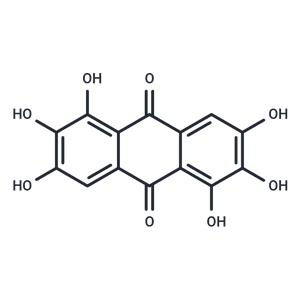
| Name | Rufigallol |
| Description | Rufigallol (AI3-00865) is an electron-deficient disk-shaped molecule with six hydroxyl groups and is a good unit for inducing the formation of DLC from non-planar AIE molecules, an anthraquinone derivative.Rufigallol induces the acquisition of DLC properties, while the introduction of TPE groups gives the molecular structure good fluorescence in the aggregated state.The remarkable synergistic in vitro antimalarial effect, in vivo with vitamin C and ketones was synergistic and showed antimalarial activity. |
| In vivo | Rufigallol, an anthraquinone derivative and exifone, a benzophenone derivative, in vitro, have remarkable synergistic antimalarial. We carried out antimalarial testing, in combination with rufigallol, in mice infected with Plasmodium berghei. Nine ketones, out of 20, showed good antimalarial activity, in vivo, when tested in combination with rufigallol, indicating the synergism between them.[1] |
| Storage | Powder: -20°C for 3 years | In solvent: -80°C for 1 year
Shipping with blue ice/Shipping at ambient temperature. |
| Solubility Information | DMSO : 3.17 mg/mL (10.42 mM), Sonication is recommended.
|
| Keywords | Rufigallol | P. falciparum | antimalarial | AI-300865 | AI 300865 |
| Inhibitors Related | Ethoxyquin | Kaolin | Allopurinol | Cysteamine hydrochloride | Hydroxychloroquine | Metronidazole | Avermectin B1a | 2-Amino-2-methyl-1-propanol | Doxycycline | Ethyl linoleate | Fenpyroximate | Dimethyl phthalate |
| Related Compound Libraries | NF-κB Signaling Compound Library | Anti-Parasitic Compound Library | Bioactive Compound Library | Immunology/Inflammation Compound Library | Bioactive Compounds Library Max | Anti-Infection Compound Library |


 United States